---
title: Adopt, Adapt, or Abandon
description: Every school initiative deserves a considered response. Learn when professional judgement should lead leaders to adopt, adapt or responsibly abandon the work.
image: https://leecrockett.net/hubfs/Decide%20First.jpg
---
[Skip to content](https://leecrockett.net/blog/adopt-adapt-or-abandon#main-content)
[](https://leecrockett.net/)
- [About](https://leecrockett.net/about)
- [Speaking](https://leecrockett.net/speaking)
- Programs
- [Leadership Archetypes](https://leecrockett.net/leadership-archetypes)
- [Excellence Program](https://leecrockett.net/culture-of-excellence-program)
- [Professional Wellness Program](https://leecrockett.net/professional-wellness)
- [Partnerships](https://leecrockett.net/partnerships)
- [Books](https://leecrockett.net/books)
- [The Sustainability Myth](https://leecrockett.net/books/sustainability-myth)
- [Culture of Excellence](https://leecrockett.net/books/culture-of-excellence)
- [Agents to Agency](https://leecrockett.net/books/agents-to-agency)
- [Future-Focused Learning](https://leecrockett.net/books/future-focused-learning)
- [Mindful Assessment](https://leecrockett.net/books/mindful-assessment)
- [Growing Global Digital Citizens](https://leecrockett.net/books/growing-global-digital-citizens)
- Resources
- [Leadership Papers](https://leecrockett.net/leadership-papers)
- [Articles](https://leecrockett.net/blog)
- [Podcast](https://leecrockett.net/podcast)
- [Videos](https://leecrockett.net/videos)
- [Contact](https://leecrockett.net/contact)
This is a search field with an auto-suggest feature attached.
- There are no suggestions because the search field is empty.
[Lee Crockett](https://leecrockett.net/blog/author/lee-crockett) August 26, 2026
# Adopt, Adapt, or Abandon
Why every initiative deserves a considered response
A school rarely becomes overloaded all at once.
It happens one reasonable decision at a time.
A priority is added because the need is real. A framework is introduced because the intent is sound. A reporting process is accepted because transparency matters. A professional learning sequence begins because practice needs to improve. A wellbeing approach is layered in because students need support. A curriculum direction is taken seriously because consistency matters.
Each decision can be defended.
Each initiative may have merit.
Each addition may make sense when viewed on its own.
The difficulty emerges later, when the accumulated weight of reasonable commitments begins to reshape the work itself. Staff are no longer only asking whether the initiative matters. They are asking how it fits with everything else. Leaders are no longer only asking whether the purpose is valid. They are asking what the next layer will displace, duplicate, complicate, or dilute.
This is one of the quiet patterns of leadership sustainability. Schools are rarely exhausted by a single initiative. They are worn down by the [accumulation of initiatives](https://leecrockett.net/blog/when-everything-arrives-as-a-priority) that were each introduced for a reason, but never fully tested against the whole.
By the time the pressure becomes visible, the school may already be carrying too much. The calendar is full. The language is crowded. Improvement conversations begin to blur. Staff hear familiar words attached to new processes. Leaders spend increasing energy connecting, explaining, sequencing, and protecting work that might have been easier to judge before it gained momentum.
That is why every initiative deserves a considered response.
Before a school moves into implementation, there is a prior leadership decision to make. The question is not simply, “How do we implement this?” The more important question is, “What kind of response does this initiative deserve in this context at this time?”
Some initiatives should be adopted. Their intent, evidence, design, timing, and fit are strong enough to warrant full implementation.
Some initiatives should be adapted. Their purpose matters, but the pathway needs to be translated for the community, capacity, timing, and work already underway.
Some initiatives should be abandoned. Their intent may already be served through stronger existing work, or their introduction may duplicate effort, weaken coherence, consume capacity, or distract from what matters most.
These are not levels of enthusiasm. They are leadership responses.
Adoption is a choice. Adaptation is leadership. Abandonment can be responsible. This distinction matters particularly in systems where [compliance can quietly begin to replace professional judgement](https://leecrockett.net/blog/the-invisible-wall-of-compliance).
The discipline sits in making the decision before implementation momentum makes it for you.
> Judgement precedes implementation.
This is the leadership practice explored this week. If Strategic Compliance asks leaders to honour intent without abandoning judgement, then Adopt, Adapt, or Abandon gives that judgement an operational form. It helps leaders pause before the next reasonable initiative becomes another layer, and ask what response would best serve the intent, the community, and the work that matters most.
---
### Prefer to watch first?
Here’s the short video version of this week’s idea if you’d like a quicker way into the argument before reading further.
---
## The assumption beneath implementation
Most initiatives do not arrive as questions. They arrive as answers.
They are often presented as a pathway, model, sequence, framework, or program with its own internal logic. The design may be strong, and the purpose may be worthwhile. The difficulty is that initiatives can begin to carry an assumption that the responsible response is implementation, and that the only remaining leadership question is how quickly and faithfully the school can make it happen.
That assumption narrows professional judgement. It shifts attention from purpose to rollout, from interpretation to logistics, from coherence to completion. Once the implementation machinery begins, leaders can find themselves discussing timelines, staff briefings, resource allocation, compliance evidence, professional learning, communication plans, and reporting requirements before the most important decision has been made.
The most important decision is whether this initiative should be adopted, adapted, or abandoned in this context at this time.
That decision is not a sign of reluctance. It is part of the discipline of responsible leadership. It asks leaders to treat initiatives seriously enough to examine them before absorbing them. It recognises that school improvement depends not only on the quality of individual initiatives, but on the coherence of the whole improvement environment.
Michael Fullan’s work on educational change has long emphasised that improvement is not created by the accumulation of disconnected reforms. Sustainable improvement depends on coherence, shared purpose, capacity building, and disciplined focus (Fullan, 2001; Fullan & Quinn, 2016). This matters because an initiative can be valuable in isolation and still become unhelpful when added to a crowded improvement landscape without sufficient judgement.
The leadership question, then, is not simply whether the initiative has merit. Many initiatives have merit. The deeper question is whether this initiative, in this form, at this time, for this community, is the right next move.
## Adoption is a choice
Adoption is sometimes treated as the default response. In practice, it should be a deliberate choice.
To adopt an initiative is to decide that its purpose, design, timing, evidence, and requirements align closely enough with the school’s needs that the strongest response is to implement it with fidelity. That may be exactly what responsible leadership requires. There are moments when an initiative brings clarity, focus, structure, or evidence that the school genuinely needs.
Adoption can be powerful when the initiative addresses an important need, fits the school’s current stage of development, strengthens existing priorities, and can be implemented without fragmenting attention. In those circumstances, adopting the initiative as designed is not passive compliance. It is an active leadership decision to align effort behind a pathway that is likely to serve learners well.
> Adoption is strongest when it is chosen, not assumed.
This is where implementation science offers useful insight. Implementation is not simply the movement of an idea into action. It depends on fit, readiness, capacity, context, fidelity, adaptation, leadership support, and ongoing learning (Fixsen et al., 2005; Damschroder et al., 2009). A leader who chooses adoption still has serious work to do. Adoption does not remove the need for judgement; it concentrates judgement around readiness, support, fidelity, and monitoring.
A considered adoption decision asks: Does the initiative fit the need? Does it strengthen our current direction? Do we have the capacity to implement it well? Is the evidence strong enough? Can we support staff to understand and use it deeply? Will this help us serve learners more effectively?
When the answer is yes, adoption can bring coherence rather than clutter. It can sharpen focus rather than add noise. It can give staff a clearer pathway rather than another competing demand. But that only happens when adoption has been preceded by judgement.
## Adaptation is leadership
Adaptation is often where the most mature leadership work takes place.
Many initiatives carry a legitimate intent but need translation before they can serve a particular community well. The intent may be right, while the language, sequence, timing, evidence process, professional learning model, or implementation pathway needs adjustment. In those moments, adaptation is not a weakening of the initiative. It is the work of making the initiative responsible.
This is especially important in schools because educational work is always contextual. A strategy that fits one school may need careful reshaping in another. A professional learning model that works in a stable staff culture may need different sequencing in a school rebuilding trust. A data process that is useful in one setting may need different evidence sources in another. A curriculum direction may need to be connected to existing work rather than introduced as a separate layer.
Ronald Heifetz’s work on adaptive leadership helps explain this. Adaptive work requires people to respond to complex challenges where the answer cannot simply be delivered through authority, expertise, or technical procedure (Heifetz, Grashow, & Linsky, 2009). Schools frequently face this kind of complexity. The work is not merely to apply a solution, but to interpret the challenge, mobilise learning, and make progress in conditions that are uncertain and value-laden.
Adaptation is the leadership response that honours complexity without losing direction. It asks leaders to hold the intent steady while adjusting the means. It requires a disciplined understanding of what must remain intact and what can be responsibly changed.
> Adaptation is leadership when it protects the intent and improves the fit.
This is where adaptation differs from drift. Drift occurs when an initiative slowly loses purpose because every adjustment makes it more comfortable, familiar, or convenient. Responsible adaptation works differently. It keeps the underlying intent visible. It explains the contextual reasoning. It identifies what is being changed and why. It monitors whether the adaptation is helping the initiative serve its purpose more effectively.
In this sense, adaptation is not a softer version of adoption. It may require more judgement, more communication, and more accountability than faithful adoption. The leader has to be able to explain the intent being honoured, the evidence being considered, the contextual factors shaping the response, and the indicators that will show whether the adapted pathway is working.
## Abandonment can be responsible
Abandonment is the most easily misunderstood of the three responses.
In leadership practice, abandonment should not mean irritation, resistance, fatigue, or refusal. It should mean that a considered decision has been made that the initiative should not proceed because it would not responsibly serve the purpose in this context. The intent may already be served through stronger existing work. The timing may compromise more important priorities. The evidence may be insufficient. The initiative may duplicate effort, fragment attention, or place unreasonable demand on staff without a clear educational return.
Used responsibly, abandonment protects focus.
This is where the language matters. Abandonment is not rebellion when it is grounded in evidence, coherence, and accountability. It is a professional decision to avoid adding work that would weaken the school’s capacity to protect what matters. In some cases, the most responsible response to an initiative is to say: we understand the intent, and we will serve that intent through a different pathway.
Viviane Robinson’s work on student-centred leadership is relevant here because it keeps the focus on the educational consequences of leadership decisions. Leadership influence matters most when it is directed towards improving teaching and learning, building professional capability, and ensuring that leadership decisions are connected to learner outcomes (Robinson, 2011). That focus creates an important test for abandonment. The question is not whether the initiative is inconvenient. The question is whether adopting or adapting it would genuinely strengthen the conditions for better learning.
Abandonment becomes responsible when it is transparent, evidence-informed, and aligned with a more important commitment. It should be possible for a leader to explain why the initiative is not proceeding, how the underlying intent will still be honoured if it is legitimate, and what evidence will be used to ensure that the school is not avoiding necessary improvement.
> Abandonment can be responsible when it protects coherence, capacity, and purpose.
This is not an easy leadership move. It requires courage and clarity, particularly in systems where visible implementation is often treated as evidence of alignment. But the alternative is also risky. When schools keep adopting initiatives without sufficient judgement, they can become crowded with work that is defensible one initiative at a time and unsustainable as a whole.
## The Initiative Response Map
A useful way to hold this decision is through a simple Initiative Response Map. The map should not be treated as a procedural tool or a checklist. Its purpose is to help leaders make visible the judgement that should occur before implementation begins.
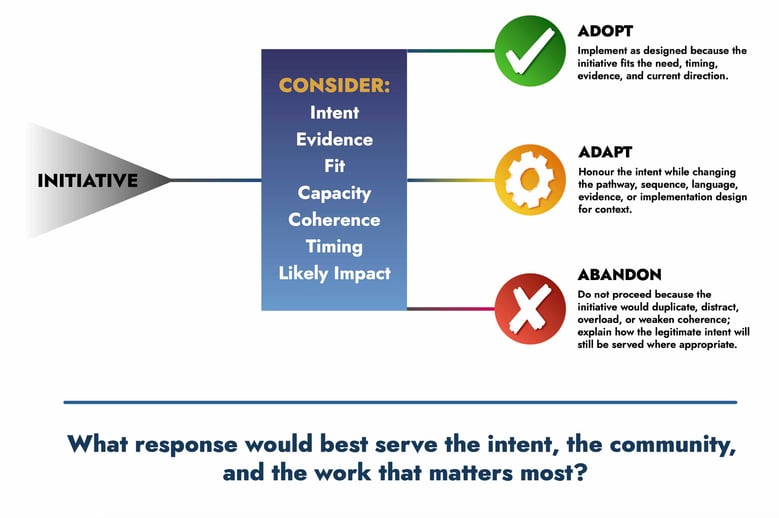
The value of the map is that it interrupts automatic implementation. It gives leaders permission to make the decision explicit before the school begins absorbing another layer of work. It also protects accountability because each response requires a reason. Adoption requires justification. Adaptation requires explanation. Abandonment requires evidence and clarity.
The three responses are not a hierarchy. Adopt is not the most compliant, adapt is not the compromise, and abandon is not the failure. Each can be the responsible response when professional judgement supports it.
## Judgement before momentum
One of the reasons initiatives become difficult to manage is that [momentum often begins before judgement is complete](https://leecrockett.net/blog/reactive-rhythms-restoring-leadership-through-pattern-recognition-and-presence).
A launch date is set. A staff meeting is scheduled. A communication is drafted. A small implementation team is formed. Resources are gathered. A reporting requirement is anticipated. Soon the school is no longer deciding whether the initiative deserves a place in the work; [it is deciding how to absorb it](https://leecrockett.net/blog/when-responding-replaces-leading-before-leaders-notice).
This is how initiative accumulation often happens, and it is one reason so many promising ideas eventually end up in what I have called [The Initiative Graveyard](https://leecrockett.net/blog/the-initiative-graveyard). It rarely occurs because leaders intentionally overload their schools. More often, each addition seems reasonable on its own. Each one has a purpose. Each one is defensible. The difficulty emerges when the combined weight of multiple defensible initiatives begins to narrow attention, weaken coherence, and reduce the professional judgement available for the work that matters most.
Implementation science helps here because it reminds us that implementation is a system, not an event. Effective implementation requires attention to readiness, support, context, feedback, and adaptation over time (Fixsen et al., 2005; Damschroder et al., 2009). If those conditions are not present, the initiative may be launched without being truly implemented. The work may become visible without becoming embedded.
That is why the decision to adopt, adapt, or abandon should come before implementation momentum takes hold. It is much harder to make a clean professional decision after the school has already invested time, identity, and public commitment in the initiative. Early judgement protects later integrity.
---
### Prefer to listen and reflect a little more deeply?
I explore this idea more fully in this week’s podcast episode, where I unpack the research, leadership dynamics, and practical implications in greater depth.
---
## A more disciplined way to respond
Adopt, Adapt, or Abandon is deliberately simple language. Its simplicity is useful, but it should not be mistaken for ease.
The discipline sits in the quality of judgement behind the response. A leader does not adopt because the initiative is mandated or fashionable. A leader does not adapt because the staff would prefer something easier. A leader does not abandon because the work is uncomfortable. Each response has to be grounded in intent, evidence, context, capacity, coherence, and likely impact.
This is where the week’s idea connects back to the larger argument of *The Sustainability Myth*. Leadership [becomes harder to sustain](https://leecrockett.net/blog/why-leadership-feels-harder-even-when-you-get-better-at-it) when leaders remain accountable for outcomes while having less space to exercise professional judgement. Initiative overload is one way this happens. The more automatic implementation becomes, the less room leaders have to interpret, sequence, adapt, and decide.
Adopt, Adapt, or Abandon restores a small but important piece of that judgement. It gives leaders a disciplined language for slowing down before adding work. It helps teams ask whether the next initiative should become part of the school’s effort, be reshaped to serve the community more responsibly, or be set aside because it would weaken coherence.
That is not procedural leadership. It is professional leadership.
Every initiative deserves a considered response because every initiative carries consequences. It uses attention. It asks for trust. It consumes capacity. It shapes what staff believe the school values. It affects what leaders can protect, monitor, explain, and sustain.
The next initiative may deserve adoption. It may deserve adaptation. It may deserve abandonment. The leadership task is to decide before momentum makes the decision for you.
## Download the full Leadership Paper
This article explores one part of a larger argument developed in my Leadership Paper, [*The Sustainability Myth: How Great Leaders Protect What Matters When Everything Is a Priority*](https://leecrockett.net/the-sustainability-myth).
The full paper develops the Judgement–Compliance Gap and explores why leadership becomes harder to sustain when leaders are held accountable for outcomes while having less room to exercise the professional judgement those outcomes require.
## [](https://leecrockett.net/hs/cta/wi/redirect?encryptedPayload=AVxigLJSD6NRTfDBR4J50C27fjVkiYQKiWWlIBDtVKfFD%2FUXvaOf8A6yONK4XTwtjpGjv1%2FZvLpLnj%2FvZF0ck2nKzhzbGg7HCxy4Fk57tTMopjmly6iVoy4tFBePruPP8m2N95nHepUyKJ5xeGMRNc%2Fvr%2BIVAiUiL%2F0GSL9UtboyFAZ9T4OwckIEJ6yf5KUx1%2BzXkXDX9tLR2nQmAJtxd2nwV6VkzcCf&webInteractiveContentId=215760903718&portalId=452492)
### References
Damschroder, L. J., Aron, D. C., Keith, R. E., Kirsh, S. R., Alexander, J. A., & Lowery, J. C. (2009). Fostering implementation of health services research findings into practice: A consolidated framework for advancing implementation science. *Implementation Science, 4*, 50.
Fixsen, D. L., Naoom, S. F., Blase, K. A., Friedman, R. M., & Wallace, F. (2005). *Implementation research: A synthesis of the literature*. University of South Florida, Louis de la Parte Florida Mental Health Institute, National Implementation Research Network.
Fullan, M. (2001). *The new meaning of educational change* (3rd ed.). Teachers College Press.
Fullan, M., & Quinn, J. (2016). *Coherence: The right drivers in action for schools, districts, and systems*. Corwin.
Heifetz, R., Grashow, A., & Linsky, M. (2009). *The practice of adaptive leadership: Tools and tactics for changing your organization and the world*. Harvard Business Press.
Robinson, V. M. J. (2011). *Student-centered leadership*. Jossey-Bass.
### More from The Briefing
##### [The Decision No Process Can Make For You](https://leecrockett.net/blog/leadership-judgement-without-certainty)
[Leadership judgement begins where certainty ends. Explore how leaders use evidence, consultation and courage to make responsible decisions under uncertainty.](https://leecrockett.net/blog/leadership-judgement-without-certainty)
##### [When Leaders Are Responsible But Not Trusted](https://leecrockett.net/blog/when-leaders-are-responsible-but-not-trusted)
[Leaders become accountable for outcomes while losing discretion over how to achieve them. Explore why responsibility without professional judgement makes leader...](https://leecrockett.net/blog/when-leaders-are-responsible-but-not-trusted)
##### [Leadership in Triage: When Responding Replaces Leading Before Leaders Notice](https://leecrockett.net/blog/when-responding-replaces-leading-before-leaders-notice)
[Explore how leadership in triage can hinder strategic direction, highlighting the importance of balancing responsiveness with intentional leadership for lasting...](https://leecrockett.net/blog/when-responding-replaces-leading-before-leaders-notice)
[](https://leecrockett.net/)
[Follow us on LinkedIn](https://www.linkedin.com/in/lee-crockett/) [Follow us on Facebook](https://www.youtube.com/@LeeCrockett)
##### Top Resources
[The Sustainability Myth Leadership Paper](https://leecrockett.net/the-sustainability-myth)
[Leadership Pressure Triangle Leadership Paper](https://leecrockett.net/leadership-pressure-triangle)
[6 Aspects of Excellence Guide](https://leecrockett.net/6-aspects-of-excellence)
[Culture of Excellence Snapshot](https://score.leecrockett.net/snapshot)
[Destinations, Milestones, Footsteps Guide](https://leecrockett.net/destinations-milestones-footsteps-guide)
##### Programs
[Leadership Archetypes Program](https://leecrockett.net/leadership-archetypes)
[Culture of Excellence Program](https://leecrockett.net/culture-of-excellence-program)
[Professional Wellness Program](https://cultureofexcellence.net/professional-wellness)
##### Company Links
[Contact Us](https://cultureofexcellence.net/contact)[Lee Crockett Media Kit](https://leecrockett.net/media-kit)
[Terms](https://get.leecrockett.net/terms-of-service) / [Privacy](https://get.leecrockett.net/privacy-policy)
[特定商取引法に基づく表記 (Commercial Disclosure)](https://leecrockett.net/commercial-disclosure)
© 2024 Lee Crockett - [leecrockett.net](https://leecrockett.net)
```json
{
"@context" : "https://schema.org",
"@type" : "BlogPosting",
"author" : {
"@type" : "Person",
"name" : "Lee Crockett",
"url" : "https://leecrockett.net/blog/author/lee-crockett"
},
"dateModified" : "2026-08-25T16:21:09.400Z",
"datePublished" : "2026-08-25T16:20:58.000Z",
"headline" : "Adopt, Adapt, or Abandon",
"image" : [ "https://leecrockett.net/hubfs/Decide%20First.jpg" ],
"mainEntityOfPage" : {
"@id" : "https://leecrockett.net/blog/adopt-adapt-or-abandon",
"@type" : "WebPage"
},
"publisher" : {
"@type" : "Organization",
"logo" : {
"@type" : "ImageObject",
"url" : "https://leecrockett.net/hubfs/Lee%20Crockett%20Logo.png"
},
"name" : "Lee Crockett"
}
}
```