---
title: Strategic Compliance
description: Explore how strategic compliance empowers school leaders to balance system expectations with community needs, enhancing educational impact and accountability.
image: https://leecrockett.net/hubfs/Honouring%20Intent.jpg
---
[Skip to content](https://leecrockett.net/blog/strategic-compliance#main-content)
[](https://leecrockett.net/)
- [About](https://leecrockett.net/about)
- [Speaking](https://leecrockett.net/speaking)
- Programs
- [Leadership Archetypes](https://leecrockett.net/leadership-archetypes)
- [Excellence Program](https://leecrockett.net/culture-of-excellence-program)
- [Professional Wellness Program](https://leecrockett.net/professional-wellness)
- [Partnerships](https://leecrockett.net/partnerships)
- [Books](https://leecrockett.net/books)
- [The Sustainability Myth](https://leecrockett.net/books/sustainability-myth)
- [Culture of Excellence](https://leecrockett.net/books/culture-of-excellence)
- [Agents to Agency](https://leecrockett.net/books/agents-to-agency)
- [Future-Focused Learning](https://leecrockett.net/books/future-focused-learning)
- [Mindful Assessment](https://leecrockett.net/books/mindful-assessment)
- [Growing Global Digital Citizens](https://leecrockett.net/books/growing-global-digital-citizens)
- Resources
- [Leadership Papers](https://leecrockett.net/leadership-papers)
- [Articles](https://leecrockett.net/blog)
- [Podcast](https://leecrockett.net/podcast)
- [Videos](https://leecrockett.net/videos)
- [Contact](https://leecrockett.net/contact)
This is a search field with an auto-suggest feature attached.
- There are no suggestions because the search field is empty.
[Lee Crockett](https://leecrockett.net/blog/author/lee-crockett) August 17, 2026
# Strategic Compliance
How great leaders honour intent while exercising professional judgement
Many school leaders recognise the moment.
A new expectation arrives. It may be a system priority, implementation requirement, reporting process, framework, evidence cycle, curriculum direction, or improvement initiative. The intent may be sound. The purpose may be legitimate. The people who designed it may be trying to improve quality, equity, transparency, consistency, or student outcomes.
Yet the leader receiving it is also holding a specific community in mind.
They know the staff history. They know the current capacity. They know which initiatives are already underway. They know which learners need urgent attention. They know where trust is strong, where it is fragile, and where another poorly timed implementation demand may produce motion without meaning.
That is the leadership moment where compliance, judgement, and responsibility meet.
A leader can treat the expectation as a ritual to be followed. They can complete the visible requirement, use the required language, submit the required evidence, and move on. Another leader may be tempted to resist, delay, reinterpret privately, or quietly protect the school from what they believe will not serve the community well.
Both responses are understandable.
Neither is fully sufficient.
The stronger leadership practice is what I call **Strategic Compliance**: the disciplined act of honouring the intent of an expectation while exercising professional judgement about how that intent should be responsibly served in context.
> Strategic Compliance is the discipline of honouring intent without abandoning judgement.
---
### Prefer to watch first?
Here's the short video version of this week's idea if you'd like a quicker way into the argument before reading further.
---
## The space between compliance and resistance
In many leadership conversations, compliance and resistance are treated as though they are the only two available positions. A leader either follows the direction or pushes back against it. They either implement the requirement or challenge it. They either align with the system or protect local context.
That framing is too narrow for the reality of school leadership.
Most experienced leaders are not looking for ways to avoid legitimate expectations. They understand why systems establish priorities. They know consistency matters. They recognise that schools belong to something larger than themselves. They also know that policy, frameworks, and implementation models cannot anticipate every learner, staff culture, community history, workload pattern, or local condition.
This is why the real leadership question is rarely, "Should we comply or resist?" A more useful question is, "What is the intent we are being asked to honour, and what does responsible action require in this context?"
That question changes the work.
It moves the leader away from ritual compliance, where the goal is simply to appear aligned. It also moves the leader away from reflexive resistance, where the system expectation is treated as something to be defended against. Strategic Compliance begins with the assumption that legitimate expectations deserve serious interpretation.
The issue is not whether the expectation matters.
The issue is how its purpose can be served responsibly.
## Intent matters more than ritual
Every system requirement carries an intent, even when that intent becomes obscured by process.
A reporting template may be designed to create transparency. A literacy initiative may be designed to improve learning. A wellbeing framework may be designed to protect students. A curriculum direction may be designed to strengthen consistency. An evidence cycle may be designed to improve decision-making.
The ritual is the visible form.
The intent is the reason the form exists.
When leaders lose sight of intent, compliance can become strangely hollow. The school may complete the form, follow the sequence, use the expected terminology, and collect the required evidence while the deeper purpose remains underdeveloped. Activity occurs. Alignment is visible. The work may even look neat from a distance.
But leadership has to ask whether the purpose has been served.
This is where Strategic Compliance becomes important. It does not treat intent casually. It takes intent seriously enough to ask whether the ritual, as designed, is the best way to serve that intent in this community at this time.
For one school, faithful implementation may be exactly the right response. The system process may fit the school's stage of development, staff readiness, community need, and existing improvement work. In that context, Strategic Compliance may look very close to conventional compliance because the prescribed pathway and local need are well aligned.
For another school, the same expectation may require careful sequencing, adaptation, translation, or integration with work already underway. The leader may need to protect the intent while changing the pacing, language, emphasis, evidence source, or implementation pathway.
That is not avoidance.
It is professional judgement being used in service of purpose.
## Context matters
Street-level professionals have always worked at the point where broad policy meets specific human reality. Lipsky's work on street-level bureaucracy gives language to this pattern: public service professionals exercise discretion because policy is necessarily general, while the people and situations it serves are specific (Lipsky, 1980).
Schools live in that gap every day.
A policy can establish direction. A framework can clarify expectations. A strategy can describe what matters. But the moment that expectation enters a school, it meets actual students, actual staff, actual families, actual histories, actual trust levels, and actual limits of attention and capacity.
Professional judgement is the bridge between those two worlds.
Donald Schön's work on reflective practice helps explain why this is not merely an implementation issue. Schön argued that professional practice often occurs in situations marked by uncertainty, complexity, uniqueness, and value conflict (Schön, 1983). In those situations, technical knowledge matters, but it must be interpreted through the reality of the situation.
That is the work school leaders are doing when they practise Strategic Compliance. They are not treating context as an excuse. They are treating context as evidence.
A highly mobile school community may need to honour a literacy priority differently from a stable school community. A school rebuilding staff trust may need to sequence professional learning differently from a school with strong collaborative routines. A school already carrying multiple high-stakes reforms may need to integrate a new expectation carefully rather than layering it on top of existing work as another visible demand.
The intent may be the same.
The responsible pathway may differ.
> Context does not weaken accountability. It tells accountability what responsible action must consider.
## Professional judgement bridges expectation and reality
Strategic Compliance depends on professional judgement because leadership is not simply a transmission function. Leaders do not merely receive expectations and pass them unchanged into their community. They interpret, translate, sequence, adapt, explain, protect, and monitor the work so that the purpose is more likely to be served.
Freidson's account of professionalism is useful here. He identified professional work as a distinct form of work grounded in specialised knowledge, ethical responsibility, and discretionary judgement (Freidson, 2001). The value of the professional is not only that they know things. It is that they can apply knowledge responsibly when the situation does not fit neatly inside a script.
This is particularly important in schools because educational improvement is rarely a simple matter of procedural transfer. A system may define an initiative, but implementation still depends on staff understanding, learner need, leadership attention, relational trust, professional learning, and coherence with existing priorities.
Fullan and Quinn's work on coherence helps deepen this point. Improvement depends on shared purpose, focused direction, collaborative cultures, deep learning, and internal accountability rather than the accumulation of disconnected initiatives (Fullan & Quinn, 2016). Strategic Compliance protects coherence by asking how a new expectation can be connected to what matters most, rather than simply added as another layer of activity.
This is where leaders can feel misunderstood.
From the outside, adaptation can be mistaken for reluctance. Sequencing can be mistaken for delay. Contextual judgement can be mistaken for inconsistency. A leader who is trying to protect intent may be seen as insufficiently compliant if the visible ritual changes.
That is why Strategic Compliance must remain disciplined, explicit, and accountable.
It should be possible for a leader to say:
- This is the intent we are honouring.
- This is the evidence we are considering.
- This is what our community currently needs.
- This is how we are adapting the pathway.
- This is how we will monitor whether the intent is being served.
Those statements matter because Strategic Compliance must never depend on hidden reasoning. Hidden judgement is too easily misread. Visible judgement can be discussed, challenged, refined, and trusted.
## The Strategic Compliance Bridge
A useful way to visualise this is as a bridge between system expectation and local reality.
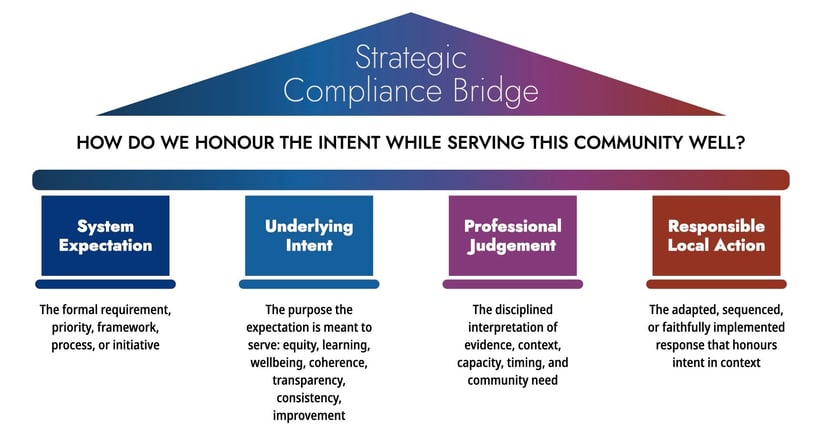
Strategic Compliance does not sit outside accountability. It sits inside a more intelligent form of accountability. The leader remains answerable for the intent, the reasoning, the adaptation, and the impact. The bridge also helps distinguish Strategic Compliance from two weaker patterns.
At one end is ritual compliance, where the form is completed but the purpose may remain untouched. At the other end is oppositional resistance, where the expectation is treated primarily as something to push against. Strategic Compliance occupies the more demanding middle space. It asks leaders to honour intent, interpret context, act responsibly, and remain accountable for the decision.
That middle space requires more professional discipline, not less.
## Two questions leaders can ask
The practical move this week is deliberately simple.
When a new expectation arrives, ask two questions before deciding how to respond.
First: **What is the intent?**
This question slows the reflex to focus only on the visible requirement. It asks what the expectation is trying to protect, improve, clarify, or make possible. It looks beneath the template, process, framework, or mandate and asks what educational purpose sits underneath.
Second: **What does our community need?**
This question brings context into the conversation without using context as an escape. It asks what learners, staff, families, and the current stage of school development require if the intent is to be served well. It considers readiness, trust, timing, capacity, existing priorities, evidence, and the likely consequences of different implementation choices.
Together, these questions create a more responsible conversation.
They prevent leaders from treating compliance as mere performance. They also prevent leaders from treating local preference as sufficient justification. Intent and context are held together. Expectation and judgement are held together. Accountability and adaptation are held together.
This is the heart of Strategic Compliance.
It is neither blind compliance nor reflexive resistance.
It is the professional discipline of translating intent into responsible action.
---
### Prefer to listen and reflect a little more deeply?
I explore this idea more fully in this week's podcast episode, where I unpack the research, leadership dynamics, and practical implications in greater depth.
---
## Strategic Compliance strengthens accountability
Strategic Compliance can only work if it remains accountable.
A leader practising Strategic Compliance should be able to explain the intent being honoured, the context being considered, the adaptation being made, and the evidence that will be used to judge whether the approach is working. Without that discipline, Strategic Compliance can become too vague. It can be misunderstood from the outside and misused from the inside.
That is why the language matters.
Strategic Compliance is not a strategy for avoiding expectations. It is a way of taking expectations seriously enough to serve their purpose rather than merely their form. It asks leaders to move beyond the appearance of alignment and towards the responsible pursuit of impact.
In the broader argument of *The Sustainability Myth*, Strategic Compliance is one response to the Judgement–Compliance Gap. When leaders are accountable for outcomes but constrained in how they can respond, the temptation is to collapse into ritual compliance or private resistance. Strategic Compliance offers a more professional pathway. It keeps leaders answerable while restoring the judgement required to lead responsibly.
The work is subtle.
It requires leaders to listen carefully to system intent, read local reality honestly, and make disciplined decisions about how the two can be brought together. It requires courage, because the responsible pathway may not always be the most obvious one. It requires humility, because professional judgement must remain open to scrutiny. It requires clarity, because hidden reasoning rarely builds trust.
Most of all, it requires leaders to remember that compliance is never the highest purpose of leadership.
The purpose is to serve learners well.
When leaders honour intent, interpret context, and remain accountable for impact, compliance becomes more than procedural alignment. It becomes a vehicle for professional responsibility.
That is Strategic Compliance.
And in an era where everything seems to arrive as a priority, it may be one of the most important practices leaders can learn to name.
---
## Download the full Leadership Paper
This article explores one part of a larger argument developed in my Leadership Paper, *The Sustainability Myth: How Great Leaders Protect What Matters When Everything Is a Priority*.
You can download the full paper here: [https://leecrockett.net/the-sustainability-myth](https://leecrockett.net/the-sustainability-myth)
[](https://leecrockett.net/hs/cta/wi/redirect?encryptedPayload=AVxigLKpqOGf7%2FgdD4QmPwF5wDhofI1PUbBga8hvZNRdDvX6XCAd9kvjyYZ9gU8qYXMz6FmVBKBj1bAMUwCDFiIOg%2FsHffuKheNVNUfe8QW7n5%2BGWp05hbpXsMdrYXCtm8lbtKkt441%2BkFsMmq8Qho%2FtzeSE%2FG4OJGcpftmzDPjDqDfpqeCoR8ktvOziuRFkvAm4MrktOVB79x%2F6oDVtFms2ftJp5CFV&webInteractiveContentId=215760903718&portalId=452492)
### References
Freidson, E. (2001). *Professionalism: The third logic*. University of Chicago Press.
Fullan, M., & Quinn, J. (2016). *Coherence: The right drivers in action for schools, districts, and systems*. Corwin.
Lipsky, M. (1980). *Street-level bureaucracy: Dilemmas of the individual in public services*. Russell Sage Foundation.
Schön, D. A. (1983). *The reflective practitioner: How professionals think in action*. Basic Books.
### More from The Briefing
##### [The Decision No Process Can Make For You](https://leecrockett.net/blog/leadership-judgement-without-certainty)
[Leadership judgement begins where certainty ends. Explore how leaders use evidence, consultation and courage to make responsible decisions under uncertainty.](https://leecrockett.net/blog/leadership-judgement-without-certainty)
##### [Trust Leaders Like We Expect Students to Think](https://leecrockett.net/blog/trust-leaders-like-we-expect-students-to-think)
[Education systems often say students need agency and judgement for the future. This article explores why sustainable leadership depends on trusting educators an...](https://leecrockett.net/blog/trust-leaders-like-we-expect-students-to-think)
##### [The Floor Cannot Become the Ceiling](https://leecrockett.net/blog/floor-cannot-become-the-ceiling)
[Education systems are understandably focused on recovery after COVID. The deeper challenge is ensuring recovery priorities strengthen learning while preserving ...](https://leecrockett.net/blog/floor-cannot-become-the-ceiling)
[](https://leecrockett.net/)
[Follow us on LinkedIn](https://www.linkedin.com/in/lee-crockett/) [Follow us on Facebook](https://www.youtube.com/@LeeCrockett)
##### Top Resources
[The Sustainability Myth Leadership Paper](https://leecrockett.net/the-sustainability-myth)
[Leadership Pressure Triangle Leadership Paper](https://leecrockett.net/leadership-pressure-triangle)
[6 Aspects of Excellence Guide](https://leecrockett.net/6-aspects-of-excellence)
[Culture of Excellence Snapshot](https://score.leecrockett.net/snapshot)
[Destinations, Milestones, Footsteps Guide](https://leecrockett.net/destinations-milestones-footsteps-guide)
##### Programs
[Leadership Archetypes Program](https://leecrockett.net/leadership-archetypes)
[Culture of Excellence Program](https://leecrockett.net/culture-of-excellence-program)
[Professional Wellness Program](https://cultureofexcellence.net/professional-wellness)
##### Company Links
[Contact Us](https://cultureofexcellence.net/contact)[Lee Crockett Media Kit](https://leecrockett.net/media-kit)
[Terms](https://get.leecrockett.net/terms-of-service) / [Privacy](https://get.leecrockett.net/privacy-policy)
[特定商取引法に基づく表記 (Commercial Disclosure)](https://leecrockett.net/commercial-disclosure)
© 2024 Lee Crockett - [leecrockett.net](https://leecrockett.net)
```json
{
"@context" : "https://schema.org",
"@type" : "BlogPosting",
"author" : {
"@type" : "Person",
"name" : "Lee Crockett",
"url" : "https://leecrockett.net/blog/author/lee-crockett"
},
"dateModified" : "2026-08-17T20:06:37.859Z",
"datePublished" : "2026-08-16T22:00:00.000Z",
"headline" : "Strategic Compliance",
"image" : [ "https://leecrockett.net/hubfs/Honouring%20Intent.jpg" ],
"mainEntityOfPage" : {
"@id" : "https://leecrockett.net/blog/strategic-compliance",
"@type" : "WebPage"
},
"publisher" : {
"@type" : "Organization",
"logo" : {
"@type" : "ImageObject",
"url" : "https://leecrockett.net/hubfs/Lee%20Crockett%20Logo.png"
},
"name" : "Lee Crockett"
}
}
```