---
title: The Five Traces of Student Thinking
description: "AI-supported learning needs practical evidence of student thinking. This Briefing names five traces leaders and teachers can look for: questions, choices, judgements, revisions and ownership."
image: https://leecrockett.net/hubfs/Five-Traces-Student-Thinking.jpg
---
[Skip to content](https://leecrockett.net/blog/the-five-traces-of-student-thinking#main-content)
[](https://leecrockett.net/)
- [About](https://leecrockett.net/about)
- [Speaking](https://leecrockett.net/speaking)
- Programs
- [Leadership Archetypes](https://leecrockett.net/leadership-archetypes)
- [Excellence Program](https://leecrockett.net/culture-of-excellence-program)
- [Professional Wellness Program](https://leecrockett.net/professional-wellness)
- [Partnerships](https://leecrockett.net/partnerships)
- [Books](https://leecrockett.net/books)
- [The Sustainability Myth](https://leecrockett.net/books/sustainability-myth)
- [Culture of Excellence](https://leecrockett.net/books/culture-of-excellence)
- [Agents to Agency](https://leecrockett.net/books/agents-to-agency)
- [Future-Focused Learning](https://leecrockett.net/books/future-focused-learning)
- [Mindful Assessment](https://leecrockett.net/books/mindful-assessment)
- [Growing Global Digital Citizens](https://leecrockett.net/books/growing-global-digital-citizens)
- Resources
- [Leadership Papers](https://leecrockett.net/leadership-papers)
- [Articles](https://leecrockett.net/blog)
- [Podcast](https://leecrockett.net/podcast)
- [Videos](https://leecrockett.net/videos)
- [Contact](https://leecrockett.net/contact)
This is a search field with an auto-suggest feature attached.
- There are no suggestions because the search field is empty.
[Lee Crockett](https://leecrockett.net/blog/author/lee-crockett) October 26, 2026
# The Five Traces of Student Thinking
If AI can improve the surface of student work, schools need clearer ways to see the thinking beneath it.
One of the most useful conversations a leadership team can have about AI-supported learning begins with a student work sample on the table. Not a policy. Not a tool demonstration. Not a debate about whether AI should be permitted. A real piece of student work, viewed with a different question in mind: what can we actually see about the learner's thinking?
This question changes the room. Teachers are used to talking about correctness, completion, criteria, marks, standards and presentation quality. Those conversations still matter. But in an AI-present world, the more revealing conversation often sits just underneath the product. What did the student ask? What did they choose? What did they judge? What did they revise? What do they now own well enough to explain and defend?
Those questions move Visible Agency from principle to practice. The earlier weeks in this campaign named the problem: [completed work no longer carries the whole story](https://leecrockett.net/blog/the-human-work-we-can-no-longer-assume), [coverage is not capability](https://leecrockett.net/blog/coverage-is-not-capability), the [Human Capability Blind Spot](https://leecrockett.net/blog/the-human-capability-blind-spot) makes important learning hard to see, and [final products need stronger process evidence](https://leecrockett.net/blog/why-student-products-are-no-longer-enough). Week 5 begins the practical response. If schools want student agency, judgement and ownership to remain visible, they need a shared language for the traces of thinking that matter most.
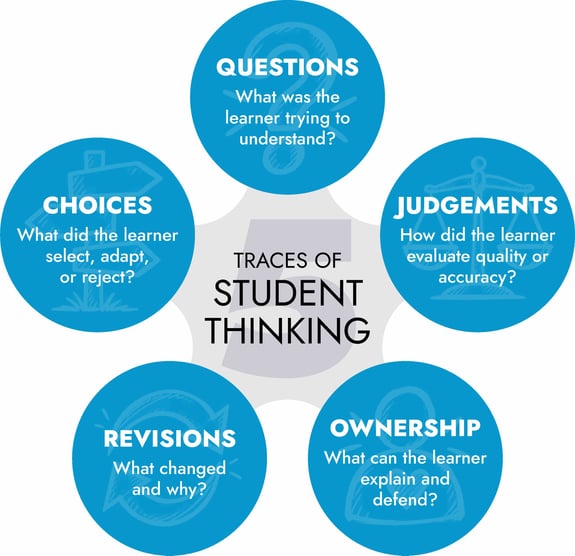
The [five traces are simple enough to remember and strong enough to guide design](https://leecrockett.net/knowledge/make-student-thinking-visible-ai): questions, choices, judgements, revisions and ownership. They are not a new marking scheme. They are not a paperwork system. They are a way of seeing whether the learner remained active inside the work when support was available.
---
### Prefer to watch first?
Here is the video version of this week's idea.
---
## 
## The First Trace Is The Question
A student's question is often the first visible trace of agency. It shows what the learner is trying to understand, test, clarify, improve or challenge. When AI is part of the process, the question matters because it reveals whether the tool is being used to finish the work or to think more carefully about the work.
A completion question asks for the product: write the paragraph, make the slides, give me the answer, improve this, solve this. A learning question asks for movement: what am I missing, what assumptions am I making, what evidence would strengthen this claim, where could this explanation fail, what are two different ways to approach this problem? The difference is not cosmetic. The question shapes the role the learner takes in the task.
> Options are useful, but options do not guarantee learning. The learning sits in the choice students make among them.
For leaders, this matters because many AI conversations become trapped at the level of permission. Was the tool allowed? Did the student disclose it? Were the boundaries clear? Those questions are necessary, but they do not tell us whether the learner used the tool with intention. A student can follow the policy and still ask questions that outsource the thinking. A student can also use AI within clear limits and ask questions that deepen the learning.
This is why questions should become part of the design conversation. If a task requires students to name the question they are pursuing before they seek support, teachers can see more than the answer. They can see the learner's direction of thought. That evidence does not need to be long. A sentence, an annotation, a prompt note or a brief conference response may be enough.
## The Second Trace Is The Choice
AI can generate options quickly. It can offer structures, phrases, arguments, summaries, images, explanations, feedback, examples and next steps. Options are useful, but options do not guarantee learning. The learning sits in the choice students make among them.
Choices show where the learner directed the work. Which suggestion did they accept? Which one did they reject? What did they adapt? What did they keep from their own first attempt? What path did they choose, and why did that choice fit the purpose of the task? These decisions often disappear in the final product because a polished piece of work can look seamless. The teacher sees the result but not the student decisions that shaped it.
Visible Agency asks schools to make a small number of those decisions visible. The aim is not to inspect every interaction with AI. The aim is to identify the meaningful choice. In a research task, it might be the source a student chose not to trust. In writing, it might be the claim they changed after comparing alternatives. In design, it might be the prototype decision they made after reviewing feedback. In mathematics or coding, it might be the solution pathway they chose and can explain.
The deeper leadership point is that [choice and agency are not the same thing](https://leecrockett.net/knowledge/visible-agency-ai-learner-agency-student-thinking). Schools sometimes speak about agency as if it is created whenever students select a topic, format or tool. Those choices can help, but agency becomes stronger when students understand the consequences of their decisions. A choice is educationally meaningful when the student can explain why it mattered.
## The Third Trace Is Judgement
Judgement is the trace that becomes more important as tools become more capable. AI can produce fluent responses that sound plausible. It can generate confident explanations, elegant summaries, convincing arguments and visually impressive outputs. Some will be useful. Some will be shallow, incomplete, inaccurate, misaligned or ethically questionable.
If students accept fluent output without evaluation, the task may produce a stronger product while weakening the learner's discernment. That is the danger. The issue is not whether students used AI. The issue is whether the task required them to judge the quality of what AI produced.
> If schools want student agency, judgement and ownership to remain visible, they need a shared language for the traces of thinking that matter most.
Judgement becomes visible when students compare, verify, test, challenge or defend. They might compare an AI explanation with a primary source. They might test a generated answer against class criteria. They might identify what was accurate, what was missing and what needed checking. They might explain why one suggestion was more relevant than another. They might notice that a response was polished but too general for the actual learning purpose.
Research on AI literacy has consistently emphasised the need for learners to understand, use, evaluate and critically reflect on AI systems and outputs (Long & Magerko, 2020; Zhang & Magerko, 2025). In school language, that means judgement has to become part of the learning design. Students need to practise discernment, and teachers need evidence that discernment happened.
## The Fourth Trace Is Revision
Revision is where learning often becomes visible because it shows that something changed. A student saw a weakness, noticed a gap, clarified an idea, corrected an error, strengthened evidence, refined a design, improved logic or reconsidered a position. The final version matters, but the movement between versions often tells the richer learning story.
AI can support revision powerfully. It can help students see gaps, generate alternatives, test language, debug code, reorganise structure or prepare for feedback. Used well, that support can strengthen learning. Used poorly, it can replace the student's responsibility for understanding why the work improved.
The key evidence is not merely that a revision occurred. The key evidence is whether the student can explain what changed and why the change improved the work or thinking. A student who says, AI made it better, is giving thin evidence. A student who says, I changed the claim because the first version did not match my evidence, is making the learning visible.
This is strongly connected to formative assessment. Evidence becomes useful when it helps teachers and learners decide what to do next (Black & Wiliam, 1998). Revision evidence can make feedback more precise because it shows how students responded to weakness, uncertainty or possibility. It turns improvement from a hidden process into something teachers and students can discuss.
## The Fifth Trace Is Ownership
Ownership is the trace that asks whether the learning has become the learner's own. It does not mean students worked alone. It does not mean every word, image, idea or structure came only from the student. In an AI-supported environment, ownership means the student can stand behind the work because they understand the decisions that shaped it.
A student shows ownership when they can explain the purpose, defend the reasoning, justify the final choices and describe how support was used responsibly. They can sit inside the work without needing the tool beside them. They know what they accepted, what they rejected, what they changed and why the final version represents their understanding.
This is where Visible Agency becomes more than process documentation. The five traces are not separate boxes. They build toward ownership. Questions show intention. Choices show direction. Judgements show discernment. Revisions show development. Ownership shows responsibility.
For leaders, ownership is the point at which AI policy meets learning design. It is possible for a student to comply with an AI policy and still have weak ownership. It is also possible for a student to use AI transparently and responsibly while demonstrating strong ownership of the learning. The difference lies in the evidence the task requires.
## A Manageable Starting Point
The practical challenge is to keep this simple enough to use. If Visible Agency becomes a demand for long process logs, it will become another burden. Teachers do not need more paperwork. They need sharper evidence.
A useful starting point is to choose one trace for one task. If the task is inquiry-heavy, focus on questions. If the task involves sources, focus on judgement. If the task involves drafting or design, focus on revision. If the task has substantial AI support, focus on ownership. The trace should match the learning purpose.
> The issue is not whether students used AI. The issue is whether the task required them to judge the quality of what AI produced.
Leaders can support teams by asking one planning question: which trace of student thinking matters most in this task, and where will students make it visible? That question is small, but it changes the design. It moves teams from assuming thinking is present to deciding where thinking will be seen.
This is the Week 5 shift. Visible Agency becomes practical when schools stop trying to see everything and start designing for the evidence that matters most. The five traces give teachers and leaders a shared language for that work.
---
### Prefer to listen and reflect more deeply?
This week's podcast explores how the five traces can change leadership conversations about evidence, workload and student responsibility.
---
The five traces are useful because they protect the human work without making the process heavy. They remind schools that the goal is not to watch every move a student makes. The goal is to see enough of the right moves to support learning.
AI has made this more urgent, but it has not changed the deeper purpose. Schools still exist to help students think, judge, revise, create and take responsibility. The difference now is that those capacities can no longer be assumed from polished work alone.
The learner has to remain visible. Questions, choices, judgements, revisions and ownership give schools a practical way to begin.
## Leadership Application
For a leadership team, the five traces become most useful when they are introduced as a shared way of looking at learning, not as another compliance expectation. The first conversation should not be, how will every teacher collect all five traces? That question makes the idea too heavy too quickly. The better first conversation is, which trace would help us see the learning we are currently missing?
A team might begin with one assessment task that already matters. Place the task, criteria and a sample of student work beside each other. Then ask which trace is most important for this learning. If the task asks students to investigate, the trace may be questions. If it asks students to use evidence, the trace may be judgement. If it asks students to improve a product, the trace may be revision. If AI support is likely, the trace may be ownership.
This conversation also helps leaders protect teacher workload. Teachers do not need to become auditors of every student action. They need to design one or two moments where the right thinking becomes visible. A single well-chosen prompt can reveal more about learning than a long generic reflection. The goal is not exhaustive visibility. The goal is useful visibility.
> Leaders can support teams by asking one planning question: which trace of student thinking matters most in this task, and where will students make it visible?
The five traces also give students clearer expectations. Instead of hearing only that AI use must be disclosed, students hear what responsible learning looks like. They learn that their questions matter. Their choices matter. Their judgements matter. Their revisions matter. Their ownership matters. This helps shift the classroom conversation from suspicion to responsibility.
The leadership opportunity is to make this language common enough that students encounter it across the school. Not identically in every subject, and not through the same template every time, but with enough coherence that they understand the deeper expectation: when support is available, the learner still needs to be visible.
## How The Five Traces Change Student Behaviour
The five traces are not only a way for teachers to see learning. They also change how students approach the work. When students know they will need to show a question, a choice, a judgement, a revision, or an ownership claim, they are less likely to treat AI as a shortcut to completion. They begin to understand that support does not remove their responsibility to think.
This is important because many AI policies focus mainly on permission and disclosure. Those things are necessary, but they do not teach students how to remain active learners. A student can disclose AI use and still have very little agency in the process. The five traces give students a clearer picture of what responsible AI-supported learning looks like.
If the trace is the question, students learn that inquiry matters before production. If the trace is the choice, they learn that generated options are not the same as decisions. If the trace is judgement, they learn that fluent output must still be tested. If the trace is revision, they learn that improvement requires understanding. If the trace is ownership, they learn that the final work must be something they can explain and defend.
This makes the classroom conversation more constructive. Instead of asking only whether students used AI, teachers can ask what kind of learner role the task required. Did students direct the support? Did they evaluate it? Did they revise with intention? Did they take responsibility for the final meaning? Those questions help students see themselves as agents in the process rather than consumers of output.
## Choosing The Right Trace
One of the most important leadership cautions is that not every task needs all five traces. If schools require every trace every time, the framework will become heavy and performative. Students will produce process evidence because the template requires it, not because it helps them learn.
The stronger move is to choose the trace that best fits the learning purpose. In an inquiry task, the question may matter most because it reveals direction. In a source-based task, judgement may matter most because students need to evaluate reliability and relevance. In a drafting task, revision may matter most because the learning is visible in what changed. In a high-support AI task, ownership may matter most because students need to show what they understand and can defend.
This keeps Visible Agency practical. It also respects teacher judgement. Different subjects will surface the traces differently. In science, judgement may appear as evaluating data or testing a claim. In English, it may appear as selecting evidence or revising reasoning. In design, it may appear as responding to constraints. In mathematics, it may appear as comparing pathways or explaining why a solution holds.
The common language matters, but the local expression should remain professional. Leaders should not turn the five traces into a rigid checklist. They should use them as a shared lens for designing evidence that is lighter, sharper, and closer to the real learning.
Download the full Leadership Paper [**Visible Agency: How to Design AI-Supported Learning Without Outsourcing Student Thinking**](https://leecrockett.net/visible-agency)
**[](https://leecrockett.net/hs/cta/wi/redirect?encryptedPayload=AVxigLKTjnAXdXiX1Mxk2LpblMm9KeDEBM3mpqC1tiCA%2BDwuYDI4areeD5WITCticRLw5DIj%2F%2Fp2DsSDcmUIBrorzoOHW5dCiyETXI7Hy3iI0x9drvyvy4FS6mwHQ1cX872xd2heG2JBDOZd6ge2UsA8Suv1Ghro79nssxetLPfQz7wVXX3Mloffr2Qakk9W1Y8NGYSGMjllJn9l5xCe&webInteractiveContentId=221700566831&portalId=452492)**
### References
Black, P., & Wiliam, D. (1998). Assessment and classroom learning. *Assessment in Education: Principles, Policy & Practice, 5*(1), 7-74.
Long, D., & Magerko, B. (2020). What is AI literacy? Competencies and design considerations. *Proceedings of the 2020 CHI Conference on Human Factors in Computing Systems*.
Zhang, C., & Magerko, B. (2025). *Generative AI literacy: A comprehensive framework for literacy and responsible use*.
### More from The Briefing
##### [Why Student Products Are No Longer Enough](https://leecrockett.net/blog/why-student-products-are-no-longer-enough)
[AI makes polished student products easier to produce and harder to interpret. Schools need better evidence of the decisions, judgement, and ownership behind the...](https://leecrockett.net/blog/why-student-products-are-no-longer-enough)
##### [The Human Capability Blind Spot](https://leecrockett.net/blog/the-human-capability-blind-spot)
[Schools often value human capability but infer it from incomplete evidence. This Briefing names the Human Capability Blind Spot and explains why visibility matt...](https://leecrockett.net/blog/the-human-capability-blind-spot)
##### [Coverage Is Not Capability](https://leecrockett.net/blog/coverage-is-not-capability)
[Curriculum coverage matters, but it is not the same as capability growth. This Briefing explores why schools need evidence of what students are becoming able to...](https://leecrockett.net/blog/coverage-is-not-capability)
[](https://leecrockett.net/)
[Follow us on LinkedIn](https://www.linkedin.com/in/lee-crockett/) [Follow us on Facebook](https://www.youtube.com/@LeeCrockett)
##### Top Resources
[The Sustainability Myth Leadership Paper](https://leecrockett.net/the-sustainability-myth)
[Leadership Pressure Triangle Leadership Paper](https://leecrockett.net/leadership-pressure-triangle)
[6 Aspects of Excellence Guide](https://leecrockett.net/6-aspects-of-excellence)
[Culture of Excellence Snapshot](https://score.leecrockett.net/snapshot)
[Destinations, Milestones, Footsteps Guide](https://leecrockett.net/destinations-milestones-footsteps-guide)
##### Programs
[Leadership Archetypes Program](https://leecrockett.net/leadership-archetypes)
[Culture of Excellence Program](https://leecrockett.net/culture-of-excellence-program)
[Professional Wellness Program](https://cultureofexcellence.net/professional-wellness)
##### Company Links
[Contact Us](https://cultureofexcellence.net/contact)[Lee Crockett Media Kit](https://leecrockett.net/media-kit)
[Terms](https://get.leecrockett.net/terms-of-service) / [Privacy](https://get.leecrockett.net/privacy-policy)
[特定商取引法に基づく表記 (Commercial Disclosure)](https://leecrockett.net/commercial-disclosure)
© 2024 Lee Crockett - [leecrockett.net](https://leecrockett.net)
```json
{
"@context" : "https://schema.org",
"@type" : "BlogPosting",
"author" : {
"@type" : "Person",
"name" : "Lee Crockett",
"url" : "https://leecrockett.net/blog/author/lee-crockett"
},
"dateModified" : "2026-10-25T21:00:00.048Z",
"datePublished" : "2026-10-25T21:00:00.000Z",
"headline" : "The Five Traces of Student Thinking",
"image" : [ "https://leecrockett.net/hubfs/Five-Traces-Student-Thinking.jpg" ],
"mainEntityOfPage" : {
"@id" : "https://leecrockett.net/blog/the-five-traces-of-student-thinking",
"@type" : "WebPage"
},
"publisher" : {
"@type" : "Organization",
"logo" : {
"@type" : "ImageObject",
"url" : "https://leecrockett.net/hubfs/Lee%20Crockett%20Logo.png"
},
"name" : "Lee Crockett"
}
}
```