
A school leader can be held accountable for almost everything and still have shrinking authority over the decisions that shape those outcomes.
They can be responsible for student achievement, staff wellbeing, attendance, inclusion, culture, community confidence, and strategic improvement. They can be expected to explain results, justify progress, evidence implementation, and respond when things fall short. Yet when the moment comes to interpret context, sequence priorities, adapt an approach, or decide what their community most needs, the room available for professional judgement may be far smaller than the responsibility they carry.
That is one of the quiet contradictions sitting beneath contemporary educational leadership: the role is increasingly experienced as answerability without equivalent authority.
The role still carries accountability. In many ways, it carries more accountability than ever. But accountability alone does not make leadership sustainable. Leaders also need the professional space to act wisely inside the realities they are responsible for improving.
When responsibility expands and discretion contracts, leadership becomes fragile.
This is not an argument against accountability. Strong leadership requires accountability. Communities deserve it, systems need it, and students benefit when schools take responsibility for the quality of their work. The deeper issue emerges when leaders carry greater answerability while the professional room to respond becomes smaller. Leaders remain accountable for outcomes, but have less space to determine how those outcomes should be pursued in the specific context they serve.
That widening distance is what I describe in The Sustainability Myth as the Judgement–Compliance Gap.
Prefer to watch first?
Here’s the short video version of this week’s idea if you’d like a quicker way into the argument before reading further.
Responsibility is not the same as authorisation
Most school leaders understand the weight of responsibility. They know that leadership is not simply a matter of preference, personality, or positional authority. It involves making consequential decisions on behalf of students, staff, families, and communities. Those decisions carry ethical weight because they affect learning, belonging, safety, opportunity, and trust.
The accepted explanation for increasing leadership pressure often returns to workload. Leaders have more to do, more people to respond to, more systems to manage, and more expectations to satisfy. That explanation is partly true. Workload is real, and it cannot be dismissed. But workload alone does not explain the particular frustration many leaders describe when they feel responsible without feeling trusted.
A more useful distinction is between responsibility and authorisation.
Responsibility names what leaders are answerable for. Authorisation names the trust, discretion, and professional room they are given to act. When these two move together, accountability can strengthen leadership. Leaders understand the outcomes they are responsible for, and they retain enough professional judgement to determine how those outcomes should be pursued in their context.
When responsibility and authorisation drift apart, accountability begins to function differently. It no longer simply clarifies what matters. It can expose leaders to consequences for outcomes they may not have had sufficient freedom to shape.
This is one of the least examined tensions in contemporary school leadership. Leaders are being asked to deliver outcomes in complex human environments while operating within increasingly prescribed conditions. They are expected to be responsive to context, but also faithful to externally determined processes. They are expected to lead improvement, but often within a narrower definition of what acceptable improvement practice looks like. They are expected to protect wellbeing, but with limited authority to reduce, sequence, or reject competing demands.
This creates a different kind of pressure from busyness.
Busyness asks, “How much can I carry?”
The Judgement–Compliance Gap asks, “Am I still authorised to lead responsibly with what I am carrying?”
That distinction matters because responsibility without discretion changes the nature of leadership. It can turn professional judgement into retrospective justification. It can make leaders cautious when they need to be adaptive. It can reward visible compliance even when contextual responsiveness would produce better outcomes. Over time, it can create organisations where leaders remain formally accountable but become less confident that they are authorised to exercise the judgement the role requires.
Responsibility requires discretion.
When discretion narrows, leaders may still make decisions. But the quality, honesty, and courage of those decisions can be affected. Some decisions become hidden. Some become performative. Some become delayed. Some become framed in the language of compliance rather than the language of purpose, evidence, and context.
That is how fragility enters the system.
Professional judgement is not optional
Professional judgement is not an optional extra that sits beside leadership. It is one of the reasons leadership exists.
Schools are not identical organisations. They serve different communities, operate with different histories, carry different levels of trust, face different staffing realities, and respond to different learner needs. A decision that is wise in one school may be poorly timed in another. An initiative that is urgent in one context may need careful sequencing in another. A strategy that builds confidence in one community may create resistance in another if the groundwork has not been done.
This is why professional work cannot be reduced to rule-following.
Donald Schön’s work on reflective practice argued that professionals operate in situations marked by uncertainty, uniqueness, and value conflict (Schön, 1983). In these situations, technical knowledge matters, but it is never enough on its own. The professional must interpret what is happening, notice what the situation is asking, and respond in ways that are both principled and contextually appropriate.
Eliot Freidson made a related argument when he described professional discretion as a defining feature of professional work (Freidson, 2001). The value of a professional is not simply that they possess knowledge. It is that they can apply knowledge responsibly when the situation does not fit neatly inside a script.
This matters deeply for educational leadership. A principal is not simply an implementation manager. A school leader must interpret competing needs, weigh consequences, read culture, protect relationships, allocate limited attention, and decide when fidelity matters and when adaptation is ethically required.
Professional judgement is not optional.
When systems attempt to increase quality through prescription alone, they may solve one problem while creating another. They may reduce some forms of variation, but they can also reduce the local judgement required to respond well to actual students, actual staff, and actual communities. The point is not that consistency is wrong. Consistency can protect equity and prevent neglect. The tension appears when consistency is pursued in ways that weaken the professional discretion needed to make consistency meaningful.
In leadership, the question is rarely, “Should we be accountable?”
A more serious question is, “What kind of accountability strengthens professional judgement, and what kind replaces it?”
Compliance can expand while trust contracts
Michael Lipsky’s work on street-level bureaucracy is useful here because it explains a pattern many school leaders recognise intuitively. Lipsky argued that public service professionals often work under conditions of high demand, limited resources, ambiguous goals, and significant discretion in practice (Lipsky, 1980). Although his work was not written specifically for school principals, the pattern is familiar: professionals are positioned at the point where policy meets human reality.
That meeting point is rarely simple.
Policy is necessarily general. Communities are specific. Frameworks are designed for coherence. Schools operate through relationships, histories, constraints, and local conditions. The leader stands in the middle, trying to honour system intent while responding to the reality in front of them.
This is where the Judgement–Compliance Gap becomes most visible.
A leader may agree with the broad direction of a reform while recognising that the sequence, pace, language, or implementation pathway needs to be adapted. They may support a wellbeing priority while knowing that staff capacity is already stretched. They may value evidence-informed practice while recognising that implementation requires cultural readiness, not just technical alignment. They may understand the need for reporting while also seeing how reporting can consume the time needed to do the work being reported on.
None of this is anti-accountability. It is accountability becoming more honest.
The difficulty is that compliance can expand while trust contracts. More templates, more reporting cycles, more implementation checks, more mandated processes, and more evidence requirements may create the appearance of assurance. Sometimes they do provide necessary visibility. But when these mechanisms multiply without corresponding professional trust, leaders may experience them less as support and more as surveillance.
Compliance can expand while trust contracts.
That contraction changes behaviour. Leaders learn which decisions are safe to name and which must be softened. They learn which adaptations can be justified and which may invite scrutiny. They learn when to speak in the language of local need and when to speak in the language of system expectation. Over time, this can create a gap between the work as performed and the work as reported.
That gap is costly because it reduces the quality of the conversation. Instead of asking, “What does this community need, and what professional reasoning supports that decision?” leaders may find themselves asking, “How do we demonstrate that we are doing what is expected?”
Those are very different questions.
Adaptive leadership requires authorised judgement
Ronald Heifetz’s work on adaptive leadership helps deepen this point. Adaptive challenges are not solved by applying existing technical procedures more efficiently. They require learning, interpretation, experimentation, and changes in values, habits, relationships, or priorities (Heifetz, 1994; Heifetz, Grashow, & Linsky, 2009).
Many of the challenges school leaders now face are adaptive in precisely this sense.
Improving student engagement is adaptive. Strengthening trust across a fractured staff culture is adaptive. Responding to complex wellbeing needs is adaptive. Building inclusion in a way that is both rigorous and humane is adaptive. Sustaining improvement while protecting staff capacity is adaptive. These challenges cannot be solved only by compliance with a procedure because the work requires people to learn, adjust, and act differently over time.
This creates an important leadership tension. Systems often respond to complexity by increasing prescription. Yet adaptive work requires disciplined judgement. The more complex the challenge, the more leaders need space to interpret, test, listen, adapt, and sequence. Without that space, they may be left with technical compliance in response to adaptive problems.
That is rarely enough.
A mandated process may create movement, but it cannot guarantee meaning. A framework may create coherence, but it cannot read the room. A reporting tool may create visibility, but it cannot build trust. A strategic priority may define direction, but it cannot determine the right next step inside every context.
This is why accountability and professional judgement need to be understood as partners rather than opposites. Accountability asks leaders to take responsibility for outcomes. Professional judgement gives them the disciplined space to determine how those outcomes can be pursued responsibly. When the two are aligned, leadership becomes both answerable and adaptive. When they are misaligned, leadership becomes exposed.
The leader is still accountable.
The judgement required to meet that accountability is less available.
Making the Judgement–Compliance Gap visible
The practical move this week is to examine where accountability and professional judgement have become misaligned.
The purpose is not to reject accountability. It is to make the relationship between responsibility and discretion visible enough to discuss. Naming matters because vague frustration often turns into private exhaustion, while precise diagnosis can create better conversations. The question is not, “Where do I want more freedom?” The better question is, “Where am I accountable for outcomes without enough discretion to respond responsibly?”
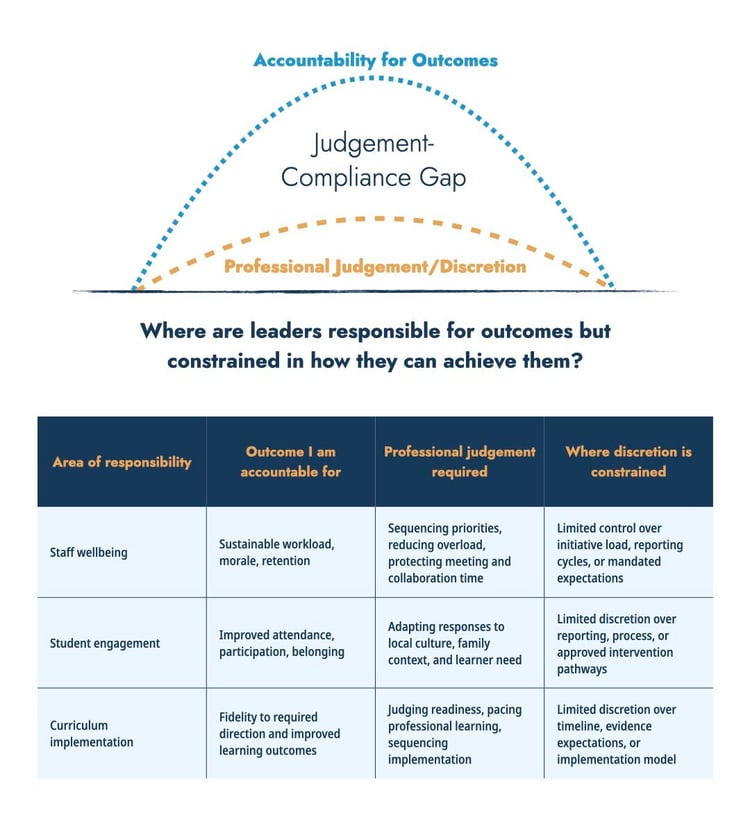
This should be used with restraint. Choose three areas, not fifteen. The aim is not to catalogue every frustration. The aim is to identify the few places where leadership responsibility is being weakened because professional discretion is unclear, insufficient, or unavailable.
A useful reflection might include four questions:
- What outcome am I genuinely accountable for?
- What professional judgement is required to influence that outcome well?
- Where is my discretion clear, limited, or absent?
- What conversation would help realign responsibility and judgement?
The power of this move is that it shifts the conversation from complaint to clarity. Instead of saying, “There is too much compliance,” a leader can say, “In this area, I am accountable for the outcome, but the discretion needed to adapt the response is unclear. Here is the effect that is having, and here is the conversation we need.”
That is a different kind of leadership conversation.
It is more disciplined.
It is more professional.
It is also more likely to be heard.
The work is to realign responsibility and judgement
The Judgement–Compliance Gap does not disappear because leaders become more resilient. It narrows when the relationship between responsibility and discretion is made visible, discussed honestly, and realigned where possible.
This matters because the sustainability challenge facing educational leadership is often treated as though it sits primarily inside individual leaders. Leaders are encouraged to manage time better, build stronger routines, protect boundaries, and strengthen personal resilience. These practices matter, and they can help. But they cannot fully resolve a structural tension between accountability and professional judgement.
A leader can have excellent time management and still be caught in the Judgement–Compliance Gap.
A leader can be deeply resilient and still become weary when responsibility expands while professional trust contracts.
A leader can believe strongly in accountability and still recognise that accountability becomes fragile when it is separated from judgement.
The deeper work is to hold accountability and professional judgement together. Schools need accountable leadership. They also need professional leadership. The more complex the work becomes, the more important that relationship becomes.
When leaders are trusted to exercise judgement, accountability becomes more intelligent. It becomes less about proving compliance and more about explaining professional reasoning. It invites leaders to say: here is our context, here is the evidence we are seeing, here is the decision we are making, here is what we are monitoring, and here is what we will adjust if the evidence changes.
That kind of accountability strengthens leadership rather than narrowing it.
Prefer to listen and reflect a little more deeply?
I explore this idea more fully in this week’s podcast episode, where I unpack the research, leadership dynamics, and practical implications in greater depth.
A closing reflection
The Judgement–Compliance Gap becomes visible wherever responsibility and discretion have drifted apart.
For school leaders, the invitation this week is to look closely at one area where you are accountable for an outcome but constrained in how you can pursue it. Name the outcome. Name the professional judgement required. Name the current constraint. Then consider what conversation would help restore the discretion needed to lead well.
Sustainable leadership does not come from lowering expectations. It comes from restoring the professional judgement required to meet them responsibly.
When leaders are trusted to interpret context, explain their reasoning, and adapt with discipline, accountability becomes more than pressure. It becomes a professional conversation about what matters, what is possible, and what responsible action now requires.
That is the work of closing the Judgement–Compliance Gap.
Download the full Leadership Paper
This article explores one part of a larger argument developed in my Leadership Paper, The Sustainability Myth: How Great Leaders Protect What Matters When Everything Is a Priority.
You can download the full paper here: https://leecrockett.net/the-sustainability-myth
