---
title: Why Leadership Attention Reveals Priorities More Honestly Than Plans
description: Discover how leadership attention shapes school priorities and culture, revealing what truly matters beyond strategic plans and intentions.
image: https://leecrockett.net/hubfs/Why-School-Priorities-Keep-Getting-Pushed-Aside.jpg
---
[Skip to content](https://leecrockett.net/blog/why-leadership-attention-reveals-priorities-more-honestly-than-plans#main-content)
[](https://leecrockett.net/)
- [About](https://leecrockett.net/about)
- [Speaking](https://leecrockett.net/speaking)
- Programs
- [Leadership Archetypes](https://leecrockett.net/leadership-archetypes)
- [Excellence Program](https://leecrockett.net/culture-of-excellence-program)
- [Professional Wellness Program](https://leecrockett.net/professional-wellness)
- [Partnerships](https://leecrockett.net/partnerships)
- [Books](https://leecrockett.net/books)
- [The Sustainability Myth](https://leecrockett.net/books/sustainability-myth)
- [Culture of Excellence](https://leecrockett.net/books/culture-of-excellence)
- [Agents to Agency](https://leecrockett.net/books/agents-to-agency)
- [Future-Focused Learning](https://leecrockett.net/books/future-focused-learning)
- [Mindful Assessment](https://leecrockett.net/books/mindful-assessment)
- [Growing Global Digital Citizens](https://leecrockett.net/books/growing-global-digital-citizens)
- Resources
- [Leadership Papers](https://leecrockett.net/leadership-papers)
- [Articles](https://leecrockett.net/blog)
- [Podcast](https://leecrockett.net/podcast)
- [Videos](https://leecrockett.net/videos)
- [Contact](https://leecrockett.net/contact)
This is a search field with an auto-suggest feature attached.
- There are no suggestions because the search field is empty.
[Lee Crockett](https://leecrockett.net/blog/author/lee-crockett) July 25, 2026
# Why Leadership Attention Reveals Priorities More Honestly Than Plans
The challenge is no longer determining importance. It is determining attention.
Most school leaders can name what matters.
They can name the improvement priorities. They can describe the student needs. They can explain the strategic plan, the wellbeing commitments, the instructional focus, the staff development agenda, and the cultural work that needs sustained attention. In many schools, the issue is no longer a lack of clarity about importance.
The issue is that attention does not always follow importance.
A leader may know that instructional leadership matters, yet spend most of the week responding to operational interruptions. They may know that culture-building matters, yet postpone the conversations that would strengthen it. They may know that middle leadership development matters, yet keep stepping in because the immediate issue feels too exposed to leave alone. They may know what deserves strategic attention and still find that the day has been claimed by what arrived with urgency.
This is the tension many leaders carry: “I know what matters. I can’t protect time for it.”
That sentence marks an important shift in the campaign. In [When Everything Arrives as a Priority](https://leecrockett.net/blog/when-everything-arrives-as-a-priority), I explored urgency overload: the pressure created when legitimate priorities all arrive as if they require immediate attention. In [Leadership in Triage](https://leecrockett.net/blog/when-responding-replaces-leading-before-leaders-notice), I explored what happens when urgency begins to shape behaviour. Leaders start responding more than leading. This week, the question becomes sharper: where is leadership attention actually going? That question only becomes necessary once [urgency has begun competing](https://leecrockett.net/blog/when-everything-arrives-as-a-priority) with every other legitimate priority.
> Attention reveals priorities more honestly than plans.
A strategic plan can name what matters. A calendar can suggest what has been scheduled. A meeting agenda can imply intention. But attention tells the deeper truth. What leaders return to, what they protect, what they interrupt, what they allow to drift, and what they repeatedly make room for all teach the organisation what matters in practice.
---
### Prefer to watch first?
Here’s the short video version of this week’s idea if you’d like a quicker way into the argument before reading further.
---
## Attention is not neutral
Attention is often treated as a personal resource, something a leader manages through better habits, stronger boundaries, or a more disciplined calendar. Those things may help, but they do not go far enough. In leadership, attention is not simply personal. It is cultural.
What receives attention becomes important. What loses attention becomes fragile. What repeatedly receives immediate attention becomes normal. What leaders protect from interruption becomes credible. Over time, the organisation learns from the leader’s attention more than from the leader’s stated intention.
This is why attention allocation is a leadership issue rather than a productivity issue.
A principal who consistently returns to instructional practice teaches the school that learning remains central. A leader who protects time for middle leadership development teaches the organisation that capacity matters. A team that repeatedly allows strategic meetings to become operational problem-solving sessions teaches itself that immediate issues have permission to take the centre.
These lessons are rarely named directly. They are absorbed through pattern.
Weick’s work on sensemaking gives language to something staff already experience: organisations learn from repeated signals. Meaning is built through cues, patterns, and social interpretation (Weick, 1995; Weick, Sutcliffe, & Obstfeld, 2005). In schools, leadership attention is one of those signals. Staff watch what leaders return to. They notice what leaders protect. They learn which issues can interrupt the agenda and which commitments are allowed to drift.
Attention therefore helps create meaning around priorities.
> What receives attention shapes culture.
A calendar may show appointments, but it does not always show what captured the leader’s mental, relational, and emotional attention. It may show the meeting, but not whether the meeting held strategic focus. It may show the classroom visit, but not whether the leader’s mind was already pulled towards the next escalation.
The issue is not simply whether leaders have time. The issue is whether attention is being directed deliberately enough to protect the work that matters before it becomes urgent.
## The difference between importance and attention
In many leadership conversations, priority-setting is treated as the central challenge. Leaders are asked to identify what matters most, narrow their focus, and align their actions accordingly. That remains useful, but for many school leaders it is no longer the hardest part.
The harder part is protecting attention once importance has already been established.
A leadership team may agree that improving feedback practice matters. They may agree that staff trust needs attention. They may agree that middle leaders need development. They may agree that student agency is a strategic priority. The plan may be clear. The language may be shared. The intention may be sincere.
Then the week begins.
A staffing gap opens. A parent issue escalates. A student incident requires response. A system request arrives. A compliance task expands. A meeting gets shortened. A strategic conversation gets deferred. None of these events may be trivial. Some may require immediate action. But together, they begin to redistribute attention away from what had been chosen.
Kahneman helps explain why the urgent often wins attention before the important has had a chance to be protected. Under conditions of speed, pressure, and salience, human attention is pulled towards what is immediate, visible, and emotionally compelling (Kahneman, 2011). In schools, urgent issues usually arrive with exactly those qualities. They are present, human, time-sensitive, and often emotionally charged.
Strategic work rarely arrives that way.
Culture-building usually asks quietly. Professional learning requires repeated attention before results become visible. Capacity-building takes patience. Trust is shaped through consistent behaviour over time. These areas can be profoundly important while rarely becoming loud enough to claim the moment.
That is the leadership problem.
Importance does not protect attention by itself.
> Attention is leadership’s scarcest resource.
Once leaders see this, the nature of the work changes. The question is no longer only, “What matters?” The sharper question is, “What is receiving attention, and what is being displaced because of it?”
This reframing protects the article from becoming another piece of prioritisation advice. The problem is not that leaders do not know how to make lists. The problem is that attention is continuously being recruited by urgency, escalation, and visibility.
## Every yes is an unseen no
Attention always carries an opportunity cost.
Every yes gives shape to the week. It places one concern at the centre and pushes another concern towards the edge. Some yeses are necessary. Some are ethical. Some protect trust. Some prevent harm. But every yes still carries a cost.
A leader who spends the morning resolving an urgent staffing issue may be doing essential work. The unseen no may be the coaching conversation that gets postponed. A leadership team that spends a strategic meeting solving operational problems may be responding responsibly. The unseen no may be the sensemaking work needed to align staff around a longer-term change. A principal who becomes the default resolver for every parent escalation may be protecting the school in the moment. The unseen no may be the development of middle leadership authority.
None of these trade-offs are simple. That is why they matter.
Mintzberg’s account of managerial work shows how leaders often operate through fragmentation, interruption, brevity, and rapid shifts of attention (Mintzberg, 1973). In schools, these shifts are relational and ethical as well as operational. A leader is constantly weighing competing claims: the person in front of them, the strategy already chosen, the risk of delay, the cost of interruption, the staff member who needs support, the community expectation, and the long-term work that does not announce itself with urgency.
Under these conditions, attention can be consumed without ever being intentionally allocated.
This is how leaders can finish a week exhausted but unsure whether the work that mattered most received enough of them. They were not inactive. They were not careless. They were not confused about priorities. Their attention was claimed, again and again, by work that appeared more immediate than the work they had intended to protect. Over time, this is how [leadership effort can continue increasing while strategic traction quietly diminishes](https://leecrockett.net/blog/why-leadership-efforts-grow-while-traction-shrinks).
> Every yes is an unseen no.
The discipline is not to say no to everything. That would be simplistic and irresponsible. The discipline is to make the hidden trade-offs visible enough to lead them.
## The Attention Alignment Audit
The practical move this week is an attention audit. More specifically, it is an **Attention Alignment Audit**.
The purpose is not to measure productivity or tighten the calendar. It is to compare what leaders say matters with what actually receives leadership attention.
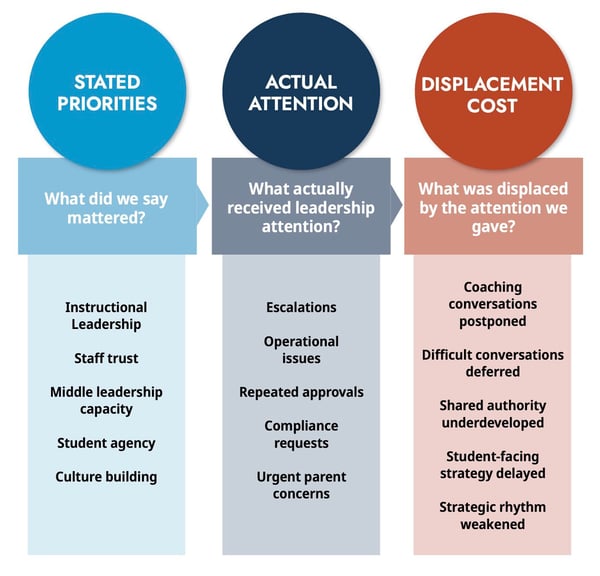
The third column is the most important. Without it, the exercise becomes a simple comparison between intention and reality. The displacement column shows the leadership consequence. It reveals the unseen no carried inside every yes.
The audit is not designed to produce guilt. It is designed to restore visibility.
Attention often drifts quietly. It is absorbed by the next issue, the next request, the next interruption, the next emotionally charged concern. Without a deliberate audit, leaders may only notice the drift when strategic work has already lost momentum.
The purpose is to create a more honest conversation.
A leadership team might ask: “If someone looked only at where our attention went last week, what would they conclude our priorities were?”
That question is uncomfortable because it bypasses intention. It does not ask what the plan says. It asks what the organisation has been taught through attention.
## Attention and adaptive leadership
Heifetz’s work on adaptive leadership helps sharpen this further. Adaptive challenges require learning, changed behaviour, shared responsibility, and sustained attention over time (Heifetz, 1994; Heifetz, Grashow, & Linsky, 2009). They cannot be solved through immediate technical response alone.
This matters because the most important leadership work in schools is often adaptive. Building trust is adaptive. Strengthening professional culture is adaptive. Developing middle leadership is adaptive. Shifting instructional practice is adaptive. Increasing student agency is adaptive. These require attention over time because they involve belief, behaviour, identity, and relationships.
Urgency repeatedly pulls leaders towards technical response because technical response offers visible relief. A problem appears. A decision is made. A concern is answered. A meeting is redirected. The pressure eases. The organisation feels movement.
Adaptive work rarely offers that kind of immediate relief.
It requires leaders to return to the same deeper priorities repeatedly, even when they are not loud. It asks leaders to protect the conversation that does not yet feel urgent. It asks teams to stay with discomfort long enough for learning to occur. It asks the organisation to develop capacity rather than rely on constant resolution from the top.
That is why attention reveals priorities more honestly than plans. Adaptive work survives only when leaders protect attention for it deliberately.
> What leaders protect from interruption becomes credible.
When leaders repeatedly protect attention for adaptive work, the organisation learns that the work is real. When that attention is repeatedly surrendered to whatever escalates, the organisation learns something else. It learns that strategic language may be sincere, but immediacy still governs the day.
## Returning attention to intention
The point of an attention audit is not to create another leadership task. It is to restore the relationship between attention and intention.
Leaders do not need a more sophisticated way to say that everything matters. They need a more honest way to see what their leadership attention is actually reinforcing. That honesty can be confronting, but it is also clarifying.
A team may discover that a stated priority is receiving almost no protected attention. It may discover that operational issues are repeatedly consuming the spaces designed for strategy. It may discover that certain people, problems, or processes have learned how to claim attention more effectively than long-term cultural work. It may discover that every yes has been carrying an unseen no.
The value is not in blaming the leader. The value is in making the pattern visible enough to change. Awareness alone is rarely enough; sustainable improvement depends on [turning insight into shared leadership practice](https://leecrockett.net/blog/insight-is-not-the-same-as-change).
---
### Prefer to listen and reflect a little more deeply?
I explore this idea more fully in this week’s podcast episode, where I unpack the research, leadership dynamics, and practical implications in greater depth.
---
Attention is leadership’s scarcest resource because it carries more than time. It carries meaning, credibility, culture, and direction. What leaders attend to repeatedly becomes what the organisation believes is real.
The challenge is no longer simply determining importance. Many leaders already know what matters. The challenge is determining attention: what receives it, what loses it, and what the organisation learns as a result.
The work that matters most will not always fight for space on its own. It must be protected, returned to, and made visible through attention.
Plans name intention. Attention tests it. Culture forms in the gap between what leaders say they value and what they repeatedly protect.
That is how intention becomes culture.
## Where to go next
This article explores how leadership attention, more than stated priorities, teaches an organisation what really matters.
- To understand why urgency so often captures leadership attention before strategy can, read [**When Everything Arrives as a Priority**](https://leecrockett.net/blog/when-everything-arrives-as-a-priority)
- To diagnose where leadership pressure is actually being generated across your school, read [**Leadership Pressure Triangle**](https://leecrockett.net/leadership-pressure-triangle)
## Download the full Leadership Paper
This article explores one idea from my Leadership Paper, *The Sustainability Myth: How Great Leaders Protect What Matters When Everything Is a Priority*.
If this article gave language to something you are experiencing, the full paper develops the deeper argument: educational leadership becomes unsustainable when leaders remain accountable for outcomes while becoming increasingly constrained in the professional judgement required to interpret, sequence, adapt, and decide.
You can download the full Leadership Paper here: [https://leecrockett.net/the-sustainability-myth](https://leecrockett.net/the-sustainability-myth)
[](https://leecrockett.net/hs/cta/wi/redirect?encryptedPayload=AVxigLJcxq5AVCCicGO9sCpwQEi%2FGWsQonCkNaBWlwS0RTlKvhM5hXEhKkE%2FYJoVgH3I1TV0SBQ155asrvrt%2FUd8ooXODSUSRmBeQIigzVRGBxuNxdAk%2FtTaIGxCbxxtjnIkk4fU%2BIMwsOW%2BnGFo1hO%2B1taY8p%2FnwStCwx37AkANwzCS3TUW2yiqivlHOy0OeMU5Ac4kbMDv5Ue7535Uz%2Bn4%2FF1HKgby&webInteractiveContentId=215760903718&portalId=452492)
### References
Heifetz, R. A. (1994). *Leadership without easy answers*. Harvard University Press.
Heifetz, R. A., Grashow, A., & Linsky, M. (2009). *The practice of adaptive leadership: Tools and tactics for changing your organization and the world*. Harvard Business Press.
Kahneman, D. (2011). *Thinking, fast and slow*. Farrar, Straus and Giroux.
Mintzberg, H. (1973). *The nature of managerial work*. Harper & Row.
Weick, K. E. (1995). *Sensemaking in organizations*. Sage.
Weick, K. E., Sutcliffe, K. M., & Obstfeld, D. (2005). Organizing and the process of sensemaking. *Organization Science, 16*(4), 409–421.
### More from The Briefing
##### [Leadership in Triage: When Responding Replaces Leading Before Leaders Notice](https://leecrockett.net/blog/when-responding-replaces-leading-before-leaders-notice)
[Explore how leadership in triage can hinder strategic direction, highlighting the importance of balancing responsiveness with intentional leadership for lasting...](https://leecrockett.net/blog/when-responding-replaces-leading-before-leaders-notice)
##### [When Leaders Are Responsible But Not Trusted](https://leecrockett.net/blog/when-leaders-are-responsible-but-not-trusted)
[Leaders become accountable for outcomes while losing discretion over how to achieve them. Explore why responsibility without professional judgement makes leader...](https://leecrockett.net/blog/when-leaders-are-responsible-but-not-trusted)
##### [When Everything Arrives as a Priority](https://leecrockett.net/blog/when-everything-arrives-as-a-priority)
[Explore how urgency overload impacts school leadership, complicating decision-making and prioritisation amidst a landscape of competing demands.](https://leecrockett.net/blog/when-everything-arrives-as-a-priority)
[](https://leecrockett.net/)
[Follow us on LinkedIn](https://www.linkedin.com/in/lee-crockett/) [Follow us on Facebook](https://www.youtube.com/@LeeCrockett)
##### Top Resources
[The Sustainability Myth Leadership Paper](https://leecrockett.net/the-sustainability-myth)
[Leadership Pressure Triangle Leadership Paper](https://leecrockett.net/leadership-pressure-triangle)
[6 Aspects of Excellence Guide](https://leecrockett.net/6-aspects-of-excellence)
[Culture of Excellence Snapshot](https://score.leecrockett.net/snapshot)
[Destinations, Milestones, Footsteps Guide](https://leecrockett.net/destinations-milestones-footsteps-guide)
##### Programs
[Leadership Archetypes Program](https://leecrockett.net/leadership-archetypes)
[Culture of Excellence Program](https://leecrockett.net/culture-of-excellence-program)
[Professional Wellness Program](https://cultureofexcellence.net/professional-wellness)
##### Company Links
[Contact Us](https://cultureofexcellence.net/contact)[Lee Crockett Media Kit](https://leecrockett.net/media-kit)
[Terms](https://get.leecrockett.net/terms-of-service) / [Privacy](https://get.leecrockett.net/privacy-policy)
[特定商取引法に基づく表記 (Commercial Disclosure)](https://leecrockett.net/commercial-disclosure)
© 2024 Lee Crockett - [leecrockett.net](https://leecrockett.net)
```json
{
"@context" : "https://schema.org",
"@type" : "BlogPosting",
"author" : {
"@type" : "Person",
"name" : "Lee Crockett",
"url" : "https://leecrockett.net/blog/author/lee-crockett"
},
"dateModified" : "2026-07-24T20:00:33.149Z",
"datePublished" : "2026-07-24T20:00:23.000Z",
"headline" : "Why Leadership Attention Reveals Priorities More Honestly Than Plans",
"image" : [ "https://leecrockett.net/hubfs/Why-School-Priorities-Keep-Getting-Pushed-Aside.jpg" ],
"mainEntityOfPage" : {
"@id" : "https://leecrockett.net/blog/why-leadership-attention-reveals-priorities-more-honestly-than-plans",
"@type" : "WebPage"
},
"publisher" : {
"@type" : "Organization",
"logo" : {
"@type" : "ImageObject",
"url" : "https://leecrockett.net/hubfs/Lee%20Crockett%20Logo.png"
},
"name" : "Lee Crockett"
}
}
```