---
title: The 5 Signs That Prove Students Are Actually Thinking
description: Discover five essential traces of student thinking that reveal true engagement in AI-supported learning, enhancing educational outcomes and ownership.
image: https://leecrockett.net/hubfs/Five-Traces-Student-Thinking.jpg
---
[Skip to content](https://leecrockett.net/podcast/the-5-signs-that-prove-students-are-actually-thinking#main-content)
[](https://leecrockett.net/)
- [About](https://leecrockett.net/about)
- [Speaking](https://leecrockett.net/speaking)
- Programs
- [Leadership Archetypes](https://leecrockett.net/leadership-archetypes)
- [Excellence Program](https://leecrockett.net/culture-of-excellence-program)
- [Professional Wellness Program](https://leecrockett.net/professional-wellness)
- [Partnerships](https://leecrockett.net/partnerships)
- [Books](https://leecrockett.net/books)
- [The Sustainability Myth](https://leecrockett.net/books/sustainability-myth)
- [Culture of Excellence](https://leecrockett.net/books/culture-of-excellence)
- [Agents to Agency](https://leecrockett.net/books/agents-to-agency)
- [Future-Focused Learning](https://leecrockett.net/books/future-focused-learning)
- [Mindful Assessment](https://leecrockett.net/books/mindful-assessment)
- [Growing Global Digital Citizens](https://leecrockett.net/books/growing-global-digital-citizens)
- Resources
- [Leadership Papers](https://leecrockett.net/leadership-papers)
- [Articles](https://leecrockett.net/blog)
- [Podcast](https://leecrockett.net/podcast)
- [Videos](https://leecrockett.net/videos)
- [Contact](https://leecrockett.net/contact)
This is a search field with an auto-suggest feature attached.
- There are no suggestions because the search field is empty.
[Lee Crockett](https://leecrockett.net/podcast/author/lee-crockett) October 26, 2026
# The 5 Signs That Prove Students Are Actually Thinking
Key takeaways:
- AI-supported learning requires clearer evidence of the learner inside the work.
- Questions, choices, judgements, revisions and ownership give leaders and teachers practical language for visible process.
- The goal is better evidence, not more documentation.
- Schools can begin by choosing one trace for one task.
---
## The 5 Signs That Prove Students Are Actually Thinking
### Transcript
There is a particular kind of professional pause that happens when teachers look carefully at student work now.
The work may be strong. It may be coherent. It may be polished in ways that would once have been reassuring. The student has submitted something that looks complete, and the criteria may be visibly addressed. But the room still hesitates, because the evidence feels thinner than the product appears.
The question underneath the pause is not always suspicion. It is not always about cheating. Often it is a more educational question: where is the learner inside this work?
That is the question I want to sit with today.
In this episode, I want to explore one practical move in the Visible Agency conversation: the five traces of student thinking. Questions. Choices. Judgements. Revisions. Ownership.
These five traces matter because they help schools avoid two unhelpful extremes. One extreme is to keep trusting final products as if nothing has changed. That is no longer enough. The other extreme is to ask students to document everything they do with AI until the process becomes heavier than the learning. That will not last, and it will not help teachers.
Visible Agency asks for something more disciplined. It asks schools to identify the moments where the human work of learning matters most, and to make those moments visible enough to discuss, teach and strengthen.
The first trace is the question.
A question tells us what the learner is trying to understand. It reveals direction. It tells us whether the student is using support to avoid thinking or to enter the thinking more carefully.
When a student begins with, write this for me, the learner's role is thin. When a student begins with, what might be missing from my argument, or what assumptions should I test, or what evidence would strengthen this claim, something different is happening. The student is not merely requesting a product. They are shaping an inquiry.
That distinction matters for leaders because policy language alone will not produce it. A school can have a clear AI policy and still have tasks where students ask completion questions. A school can also have clear boundaries and design tasks where students learn to ask better questions. The design matters.
The second trace is the choice.
AI gives students options. Sometimes many options. Different structures. Different phrases. Different explanations. Different examples. Different ways of organising an idea. That can be helpful, but options do not automatically produce agency. Agency appears when students choose with purpose.
What did the student use? What did they ignore? What did they change? What did they keep from their own draft? What path did they choose because it served the purpose of the work?
This is where choice becomes more serious than preference. A student choosing a font or topic may be making a choice, but not necessarily exercising deep agency. A student choosing between explanations because one better fits the evidence is showing a more meaningful form of agency. A student rejecting a fluent AI suggestion because it does not match the task is showing agency. A student adapting a structure because it clarifies the argument is showing agency.
The third trace is judgement.
This may be the trace that schools need to name most clearly. AI can be fluent without being wise. It can be plausible without being accurate. It can sound polished while missing the deeper purpose of the task.
If students are going to use AI well, they need to judge. They need to compare suggestions with evidence, criteria, sources, examples, constraints and ethical expectations. They need to ask whether an output is accurate, relevant, useful and good enough. They need to learn that confidence in the answer is not the same as quality in the thinking.
Research on AI literacy keeps pointing in this direction. Students need more than access to tools. They need the capacity to understand, evaluate and critically reflect on AI outputs. In classroom terms, they need opportunities to practise judgement.
The fourth trace is revision.
Revision is powerful because it shows movement. Something changed. A claim became sharper. A design became clearer. A source was replaced. A paragraph was reorganised. A prototype improved. A misconception was corrected.
But again, the evidence is not simply that the final version is better. The evidence is whether the student understands why it is better.
AI can suggest revisions very quickly. That can support learning if the student remains responsible for understanding the change. It can also weaken learning if improvement happens without comprehension. The teacher needs some trace of what changed and why.
This might be a short note. It might be an annotated draft. It might be a one-minute conference. It might be a comparison between two versions. It does not need to be a long reflection. It needs to reveal the learning movement.
The fifth trace is ownership.
Ownership is the point where the learner can stand behind the work. Not because they did everything alone, but because they understand the decisions that shaped the final product.
A student shows ownership when they can explain the purpose, defend the reasoning, justify the final choices and describe how support was used responsibly. They know what they accepted, what they rejected, what they changed and why the work represents their understanding.
This is one of the most important shifts in the AI conversation. We do not need students to pretend they received no support. We do need them to remain answerable for the learning. They need to be able to sit inside the work without the tool beside them.
Taken together, the five traces give leaders a practical language. Questions show intention. Choices show direction. Judgements show discernment. Revisions show development. Ownership shows responsibility.
The leadership challenge is to keep this language light enough to use and serious enough to matter.
If every task requires every trace, the idea will become too heavy. If every student has to produce a full process log every time they use AI, teachers will be buried and students will perform compliance. The better move is to choose the trace that fits the learning purpose.
If the task is inquiry-heavy, focus on the question. If it involves sources, focus on judgement. If it involves drafting, focus on revision. If the final product has had substantial AI support, focus on ownership. One well-chosen trace can reveal more than a long checklist.
This is where Visible Agency becomes a leadership practice. Leaders can help teams ask: which trace of thinking matters most here, and where will students make it visible?
That question is small, but it changes the design. It asks teachers to stop assuming that thinking is present and to decide where thinking will be seen. It protects learning without turning AI use into surveillance. It keeps the focus on the human work rather than the tool.
I also think this helps students. When students know they will need to explain a question, a choice, a judgement, a revision or an ownership claim, they approach AI differently. They begin to notice their own role. They become less passive in the process. They learn that support does not remove responsibility.
That may be one of the most important outcomes of this work. Visible Agency gives teachers better evidence, but it also gives students a clearer picture of themselves as learners. They start to see that learning is not only what appears in the submitted product. It is also the thinking they carried, shaped, tested and made their own.
So the practical invitation this week is modest. Choose one familiar task. Do not redesign the whole assessment system. Do not create a new reporting layer. Just ask: which trace of student thinking matters most in this task?
Then make that trace visible.
Ask for the question. Ask for the choice. Ask for the judgement. Ask for the revision. Ask for the ownership claim.
Small evidence, well chosen, can change the learning conversation.
That is the promise of Visible Agency. The learner does not disappear inside the support. The product still matters, but the human work behind it becomes visible enough to strengthen.
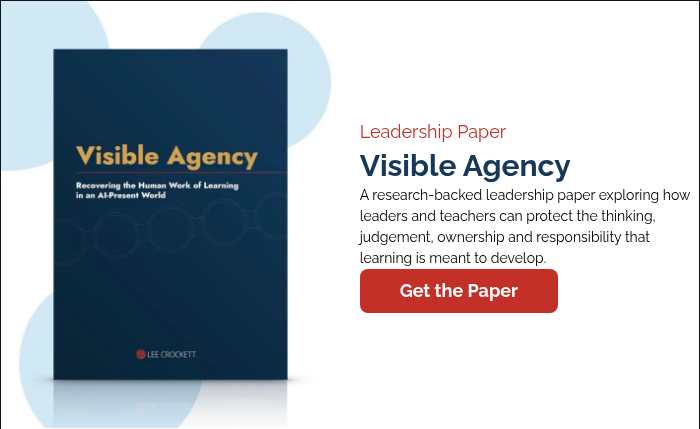
For the fuller framework, download the Visible Agency Leadership Paper at [https://leecrockett.net/visible-agency](https://leecrockett.net/visible-agency).
[](https://leecrockett.net/hs/cta/wi/redirect?encryptedPayload=AVxigLL8lloNWFsLHImtU8uk52NYxvPOMdRsxx6bYy5uff2B8tR%2BE0fvr%2BiTELfcd%2BMmNdB%2BkpD4SozVun%2Fa44WRzOOv4dxJAAhjR1ud6Vb6AphokFRapZk%2FHM4JkegNE6wxiyLvprwntOwQDHfmN9snOLoBqf6k7LT26L1sF%2FLyfYQSCPuPjKNmVeO4vKzLS2DmRKxymJ8N4NkLH%2BGW&webInteractiveContentId=221700566831&portalId=452492)
### More from The Briefing
##### [Keeping the Learner Visible in Learning](https://leecrockett.net/podcast/keeping-the-learner-visible-in-learning)
[Explore how AI impacts student work visibility and learn strategies to ensure meaningful evidence of student learning in the classroom.](https://leecrockett.net/podcast/keeping-the-learner-visible-in-learning)
##### [The Human Capability Blind Spot in Schools](https://leecrockett.net/podcast/the-human-capability-blind-spot-in-schools)
[Explore how schools can address the Human Capability Blind Spot by making essential skills like agency and judgment visible for effective teaching and learning.](https://leecrockett.net/podcast/the-human-capability-blind-spot-in-schools)
##### [Why Student Products Are No Longer Enough](https://leecrockett.net/podcast/why-student-products-are-no-longer-enough)
[Explore why student products alone can't prove learning in an AI-driven world and discover how to reconnect products with meaningful evidence of student underst...](https://leecrockett.net/podcast/why-student-products-are-no-longer-enough)
[](https://leecrockett.net/)
[Follow us on LinkedIn](https://www.linkedin.com/in/lee-crockett/) [Follow us on Facebook](https://www.youtube.com/@LeeCrockett)
##### Top Resources
[The Sustainability Myth Leadership Paper](https://leecrockett.net/the-sustainability-myth)
[Leadership Pressure Triangle Leadership Paper](https://leecrockett.net/leadership-pressure-triangle)
[6 Aspects of Excellence Guide](https://leecrockett.net/6-aspects-of-excellence)
[Culture of Excellence Snapshot](https://score.leecrockett.net/snapshot)
[Destinations, Milestones, Footsteps Guide](https://leecrockett.net/destinations-milestones-footsteps-guide)
##### Programs
[Leadership Archetypes Program](https://leecrockett.net/leadership-archetypes)
[Culture of Excellence Program](https://leecrockett.net/culture-of-excellence-program)
[Professional Wellness Program](https://cultureofexcellence.net/professional-wellness)
##### Company Links
[Contact Us](https://cultureofexcellence.net/contact)[Lee Crockett Media Kit](https://leecrockett.net/media-kit)
[Terms](https://get.leecrockett.net/terms-of-service) / [Privacy](https://get.leecrockett.net/privacy-policy)
[特定商取引法に基づく表記 (Commercial Disclosure)](https://leecrockett.net/commercial-disclosure)
© 2024 Lee Crockett - [leecrockett.net](https://leecrockett.net)
```json
{
"@context" : "https://schema.org",
"@type" : "BlogPosting",
"author" : {
"@type" : "Person",
"name" : "Lee Crockett",
"url" : "https://leecrockett.net/podcast/author/lee-crockett"
},
"dateModified" : "2026-10-25T20:59:59.924Z",
"datePublished" : "2026-10-25T20:59:59.000Z",
"headline" : "The 5 Signs That Prove Students Are Actually Thinking",
"image" : [ "https://leecrockett.net/hubfs/Five-Traces-Student-Thinking.jpg" ],
"mainEntityOfPage" : {
"@id" : "https://leecrockett.net/podcast/the-5-signs-that-prove-students-are-actually-thinking",
"@type" : "WebPage"
},
"publisher" : {
"@type" : "Organization",
"logo" : {
"@type" : "ImageObject",
"url" : "https://leecrockett.net/hubfs/Lee%20Crockett%20Logo.png"
},
"name" : "Lee Crockett"
}
}
```