---
title: The Human Capability Blind Spot in Schools
description: Explore how schools can address the Human Capability Blind Spot by making essential skills like agency and judgment visible for effective teaching and learning.
image: https://leecrockett.net/hubfs/3.3-Human-Capability-Blindspot.jpg
---
[Skip to content](https://leecrockett.net/podcast/the-human-capability-blind-spot-in-schools#main-content)
[](https://leecrockett.net/)
- [About](https://leecrockett.net/about)
- [Speaking](https://leecrockett.net/speaking)
- Programs
- [Leadership Archetypes](https://leecrockett.net/leadership-archetypes)
- [Excellence Program](https://leecrockett.net/culture-of-excellence-program)
- [Professional Wellness Program](https://leecrockett.net/professional-wellness)
- [Partnerships](https://leecrockett.net/partnerships)
- [Books](https://leecrockett.net/books)
- [The Sustainability Myth](https://leecrockett.net/books/sustainability-myth)
- [Culture of Excellence](https://leecrockett.net/books/culture-of-excellence)
- [Agents to Agency](https://leecrockett.net/books/agents-to-agency)
- [Future-Focused Learning](https://leecrockett.net/books/future-focused-learning)
- [Mindful Assessment](https://leecrockett.net/books/mindful-assessment)
- [Growing Global Digital Citizens](https://leecrockett.net/books/growing-global-digital-citizens)
- Resources
- [Leadership Papers](https://leecrockett.net/leadership-papers)
- [Articles](https://leecrockett.net/blog)
- [Podcast](https://leecrockett.net/podcast)
- [Videos](https://leecrockett.net/videos)
- [Contact](https://leecrockett.net/contact)
This is a search field with an auto-suggest feature attached.
- There are no suggestions because the search field is empty.
[Lee Crockett](https://leecrockett.net/podcast/author/lee-crockett) October 12, 2026
# The Human Capability Blind Spot in Schools
Key takeaways:
- The problem is visibility, not lack of care.
- Schools often infer agency, judgement, and ownership from incomplete evidence.
- Better evidence does not mean more documentation.
- Capability becomes teachable when it becomes visible.
- Leaders can begin by asking what important capability is currently valued more clearly than it is evidenced.
---
## The Human Capability Blind Spot in Schools
### Transcript
There is a strange thing that can happen in schools. The capabilities people care about most can be the ones they see least clearly.
A school may speak often about agency. It may value judgement. It may want students to take ownership of learning. It may include these ideas in strategic plans, graduate profiles, learning dispositions, and curriculum documents. And yet, when teachers and leaders ask what evidence they actually have, those capabilities may be more assumed than visible.
I’m Lee Crockett - welcome to the Culture of Excellence podcast.
This week I want to name that pattern: the Human Capability Blind Spot.
The blind spot is not a failure of intention. In fact, it often appears in schools with strong intentions. Leaders are not indifferent to agency. Teachers are not ignoring judgement. Nobody is saying ownership does not matter.
The issue is that schools can often see coverage, completion, and performance more clearly than the human capabilities those structures are meant to develop.
That matters because what remains invisible is harder to teach deliberately. If judgement is valued but rarely seen, it becomes difficult to discuss the quality of judgement. If ownership is assumed from completion, it becomes difficult to know whether students can stand behind the work. If metacognition is private or accidental, it becomes difficult to strengthen it as part of learning.
This is where schools can become rich in evidence and still thin in the evidence that matters most for human capability.
A completed task may suggest responsibility without showing ownership. A strong answer may suggest understanding without showing judgement. A group product may suggest collaboration without showing whether students changed each other's thinking. A polished response may suggest capability while hiding the decisions that produced it.
The point is not to distrust students. It is to improve the evidence.
Assumption is not evidence.
Formative assessment research reminds us that evidence matters because it guides next steps. Evidence is not powerful simply because it is collected. It is powerful when it helps teachers and students understand learning more clearly and act on that understanding.
If the evidence does not show the capability, feedback and improvement become less precise. A teacher can comment on the final answer, but may not be able to discuss the student's judgement. A teacher can mark the finished presentation, but may not be able to see the ownership behind it. A team can review the final product, but may not know whether students became more thoughtful, responsible, or capable.
Metacognition research points in the same direction. Students become better learners when they learn to plan, monitor, and evaluate their thinking. But those processes need to become visible within the learning experience. If they are hidden or added only as a generic reflection at the end, they are harder to teach with intention.
The answer is not to collect everything. That is an understandable overreaction, and I think it would be a mistake. If Visible Agency becomes documentation-heavy, teachers will rightly resist it. Students will experience it as compliance rather than learning.
The better move is to identify the few moments where human capability matters most.
Where did the student make a judgement? Where did they revise with intention? Where did they explain a decision? Where did they take responsibility for the final meaning? Where did they compare, reject, adapt, verify, or defend?
Those moments do not need to be large. They need to be meaningful.
A student explaining why they rejected a weak AI suggestion may reveal judgement. A short annotation showing why a revision improved meaning may reveal metacognition. A comparison between two sources may reveal discernment. A defence of a final choice may reveal ownership.
That is the point of Visible Agency. Capability becomes teachable when it becomes visible.
For leaders, the practical question is direct: what important capability are we currently inferring rather than evidencing?
If the school values agency, where does agency become visible? If it values judgement, where do students explain how they judged quality, accuracy, relevance, or usefulness? If it values ownership, where do students show that they understand and stand behind the final work?
The best answers are usually specific. Add one point in a task where students explain a decision. Add one comparison before the final product. Add one revision note that shows why a change improved meaning. Add one oral check where students explain what they understand without leaning on the product.
These small moves change the conversation. Teachers can give feedback on the quality of judgement, not only the quality of the product. Students can become more aware of their decisions, not only their completion. Leaders can see whether the capabilities they value are actually being practised.
The Human Capability Blind Spot begins to close when schools stop assuming capability is present simply because the work is complete.
One more thing is worth saying about the blind spot. It does not close because a school names more capabilities. It closes because a school chooses where those capabilities will be made visible.
That is a very different kind of leadership move. It is easy to add language to a graduate profile. It is harder to ask where students will actually show judgement in Year 7 science, ownership in Year 9 humanities, or metacognition in senior mathematics. But that harder question is where the work becomes real.
The encouraging part is that the answer does not have to be large. If a school values judgement, begin with one task where judgement genuinely matters. Ask students to explain why one source, method, design, structure, or explanation is stronger than another. If a school values metacognition, choose one task where students revise. Ask them to explain what changed in their thinking, not only what changed in the product. If a school values ownership, choose one task where students submit substantial work. Ask them to defend one decision they are prepared to stand behind.
These small moves can change teacher feedback. Instead of commenting only on the finished product, teachers can comment on the quality of a judgement, the strength of a revision, or the depth of an ownership claim. They can teach the capability because they can see it.
They also change student identity. Students begin to understand that learning is not only the thing they hand in. It is the thinking they can explain, the decisions they can justify, the changes they can account for, and the work they can stand behind.
That is why the Human Capability Blind Spot matters. It gives schools language for a gap they may have felt but not named. Once the gap is named, it can be designed for.
And the design work does not need to begin everywhere. It needs to begin somewhere specific enough to learn from.
A useful way to test the blind spot is to listen to the language teams use when they talk about student work. If the conversation stays mostly at the level of completion, accuracy, marks and presentation, the visible evidence may be product-heavy. If the conversation includes how students made decisions, how they evaluated quality, how they revised, and what they can defend, the school is beginning to see capability more clearly.
This does not mean every meeting needs to become longer. It means one question can deepen the meeting: what are we currently assuming from this work that we may need to see more clearly?
That question is powerful because it separates care from evidence. A teacher may care deeply about agency, but if the task does not show agency, the teacher has little to respond to. A leader may value judgement, but if the system never asks where judgement becomes visible, the capability remains hidden inside finished products.
When the blind spot narrows, feedback changes. Students do not only hear that their final answer was strong or weak. They hear that their judgement was careful, their revision strengthened the reasoning, their ownership claim was thin, or their decision needed stronger evidence. That is much more useful learning feedback.
It also makes the school's values more honest. If we say we value human capability, then we need to design learning where human capability can be seen, discussed and strengthened.
That is the work. Not more slogans. Not more paperwork. Better visibility of the capabilities that matter most.
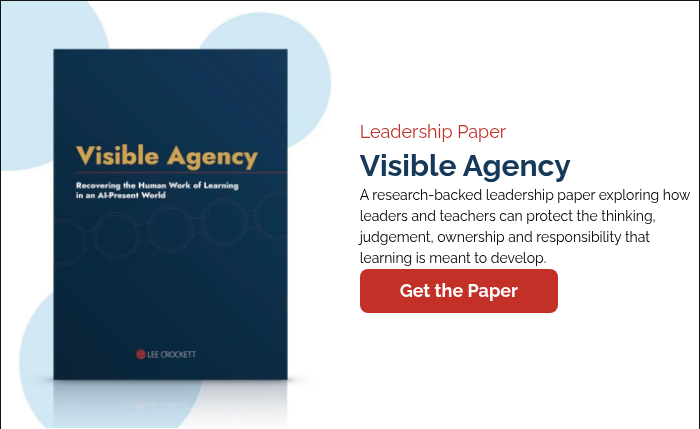
For the fuller framework, download the Visible Agency Leadership Paper at [https://leecrockett.net/visible-agency](https://leecrockett.net/visible-agency).
[](https://leecrockett.net/hs/cta/wi/redirect?encryptedPayload=AVxigLJg2zR%2FDHS588KLeyntQ3F76EqPJ7fPVs18%2FVfI6i3PHyZBGDOXxj8NaXekD09bmElqBXxfJ2L4kgJzQkd%2FFiGGaiX8uGK%2FeWsOGs91WonX7%2BW8Km1T%2FXH4aCA5OkNJnmNs5WxO5JbYboorNqQGGoNQBBz4uLa8RalDz6EicQVMOWa7Y6Ib3CuHS9EuXE3w5wcUJ6tbgmZJgcSz&webInteractiveContentId=221700566831&portalId=452492)
[](https://leecrockett.net/)
[Follow us on LinkedIn](https://www.linkedin.com/in/lee-crockett/) [Follow us on Facebook](https://www.youtube.com/@LeeCrockett)
##### Top Resources
[The Sustainability Myth Leadership Paper](https://leecrockett.net/the-sustainability-myth)
[Leadership Pressure Triangle Leadership Paper](https://leecrockett.net/leadership-pressure-triangle)
[6 Aspects of Excellence Guide](https://leecrockett.net/6-aspects-of-excellence)
[Culture of Excellence Snapshot](https://score.leecrockett.net/snapshot)
[Destinations, Milestones, Footsteps Guide](https://leecrockett.net/destinations-milestones-footsteps-guide)
##### Programs
[Leadership Archetypes Program](https://leecrockett.net/leadership-archetypes)
[Culture of Excellence Program](https://leecrockett.net/culture-of-excellence-program)
[Professional Wellness Program](https://cultureofexcellence.net/professional-wellness)
##### Company Links
[Contact Us](https://cultureofexcellence.net/contact)[Lee Crockett Media Kit](https://leecrockett.net/media-kit)
[Terms](https://get.leecrockett.net/terms-of-service) / [Privacy](https://get.leecrockett.net/privacy-policy)
[特定商取引法に基づく表記 (Commercial Disclosure)](https://leecrockett.net/commercial-disclosure)
© 2024 Lee Crockett - [leecrockett.net](https://leecrockett.net)
```json
{
"@context" : "https://schema.org",
"@type" : "BlogPosting",
"author" : {
"@type" : "Person",
"name" : "Lee Crockett",
"url" : "https://leecrockett.net/podcast/author/lee-crockett"
},
"dateModified" : "2026-10-11T20:59:59.883Z",
"datePublished" : "2026-10-11T20:59:59.000Z",
"headline" : "The Human Capability Blind Spot in Schools",
"image" : [ "https://leecrockett.net/hubfs/3.3-Human-Capability-Blindspot.jpg" ],
"mainEntityOfPage" : {
"@id" : "https://leecrockett.net/podcast/the-human-capability-blind-spot-in-schools",
"@type" : "WebPage"
},
"publisher" : {
"@type" : "Organization",
"logo" : {
"@type" : "ImageObject",
"url" : "https://leecrockett.net/hubfs/Lee%20Crockett%20Logo.png"
},
"name" : "Lee Crockett"
}
}
```