
There is a conversation I have been having with school leaders for years. It appears in different places and different forms, but the underlying question is remarkably consistent. Sometimes it surfaces after a keynote, when the room has emptied and a principal finally says what they were thinking. Sometimes it emerges during a coaching conversation, when an experienced deputy reflects on how much they have grown as a leader and then admits that the role still feels heavier than it once did. The question is usually some version of this: Why does leadership feel harder than it used to?
What makes the question worth paying attention to is the calibre of the people asking it. These are often experienced, reflective, deeply committed leaders who have spent years refining their practice. They understand strategy, culture, communication, improvement, and change more deeply than they did earlier in their careers. They have stronger systems, sharper instincts, and greater perspective. In almost every measurable sense, they have become more capable.
That is what makes the pattern so interesting. Experience should create steadiness. Better systems should reduce friction. Stronger judgement should make complexity easier to navigate. Yet many capable leaders describe a growing sense that the role has become harder to sustain.
The better they become at leadership, the heavier leadership seems to feel.
Prefer to watch first?
Here’s the short video version of this week’s idea if you’d like a quicker way into the argument before reading further.
The Explanation We Already Know
The most common explanation is workload, and there is strong evidence to support that concern. Across Australia and internationally, research continues to identify workload, emotional labour, role complexity, accountability pressure, and administrative burden as significant contributors to leadership strain. This connects with the broader framework I explored in Leadership Pressure Triangle, where pressure is examined as a pattern that can reshape leadership behaviour long before sustainability becomes the visible concern. Riley’s work on principal wellbeing has repeatedly highlighted the pressure carried by school leaders, while Day and Gu’s work on resilient leadership shows how demanding it can be to sustain commitment, energy, and effectiveness over time.
Most leaders do not need research to confirm the lived reality. They see it in calendars that fill faster than they can be protected. They feel it in the constant arrival of new priorities, each carrying a legitimate purpose and its own claim on attention. They experience it in staffing challenges, compliance requirements, parent expectations, student wellbeing concerns, and improvement agendas that continue to accumulate faster than older expectations are removed.
Workload deserves serious attention because capacity matters. Time matters. Energy matters. Human beings cannot absorb unlimited demand indefinitely. Any serious conversation about leadership sustainability must begin by acknowledging that the pressure leaders describe is real, not imagined.
One of the reasons this question has stayed with me is that workload, while real, never seemed to fully explain what I was hearing. The leaders raising these concerns were describing a growing tension between what they were responsible for and the professional space they felt they had to respond. Their concern was less about whether they could do the work and more about why the work had become so difficult to sustain.
That observation does not invalidate the workload argument. It simply suggests we may need to look more deeply at the conditions that make leadership sustainable.
The sustainability challenge is often framed as a workload problem. It may be more accurately understood as a professional judgement problem.
The Resource We Rarely Measure
Most discussions about sustainability focus on visible resources: time, staffing, funding, administrative support, professional learning, and wellbeing structures. These are important because they shape a leader’s capacity to respond to the demands of the role. Bakker and Demerouti’s Job Demands–Resources model is useful here because it reminds us that pressure is shaped not only by the demands people face, but also by the resources available to meet those demands.
There is another leadership resource we rarely name with the same seriousness: professional judgement. Every day, school leaders interpret context, weigh competing priorities, sequence initiatives, respond to community needs, and make decisions in circumstances where there is rarely a single correct answer.
Leadership is not simply the work of implementation. It is the work of interpretation.
A leader can have better systems and still feel constrained if the space to exercise judgement is narrowing. A leader can be more experienced and still feel less sustainable if their work increasingly requires them to implement, report, respond, and comply without enough room to interpret what their community actually needs. The pressure is not only the volume of work. It is the growing difficulty of doing the right work in the right way for the right reasons.
Heifetz’s work on adaptive leadership helps explain why this matters. Many leadership challenges are not technical problems with fixed answers. They require interpretation, learning, judgement, and adaptation. When adaptive work is treated mainly as implementation work, leadership starts to feel different. Leaders remain accountable for outcomes, yet the professional space required to determine how those outcomes should be achieved begins to narrow.
A Different Sustainability Audit
One practical way to reframe the conversation is to separate leadership pressure into three forms. The first is workload pressure: the visible volume of tasks, meetings, emails, reports, conversations, deadlines, initiatives, and operational demands that fill the day. This is the form of pressure leaders usually name first because it is the easiest to see.
The second is complexity pressure. This is created by the number of variables leaders must hold together when making decisions. A staffing decision is rarely only a staffing decision. It may involve learner needs, staff wellbeing, parent expectations, industrial requirements, budget constraints, strategic priorities, and long-term cultural implications. Complexity pressure is not simply about how much work exists. It is about how much interdependence sits inside the work.
The third is judgement pressure. This is the pressure created when leaders remain accountable for outcomes while feeling increasingly constrained in how they can respond. It appears when leaders understand their learners, staff, and community, yet feel limited in their ability to adapt, sequence, contextualise, or prioritise the expectations arriving around them. It can be difficult to name because it does not appear as another meeting or deadline. It appears as a gradual loss of professional space.
These pressures do not operate in isolation. They accumulate. A leader can carry significant workload pressure and substantial complexity pressure while still remaining sustainable if professional judgement remains intact. Demanding work can remain sustainable when leaders retain the space to interpret context, make disciplined choices, and protect what matters.
This is what I now think of as the Sustainability Pressure Gauge.
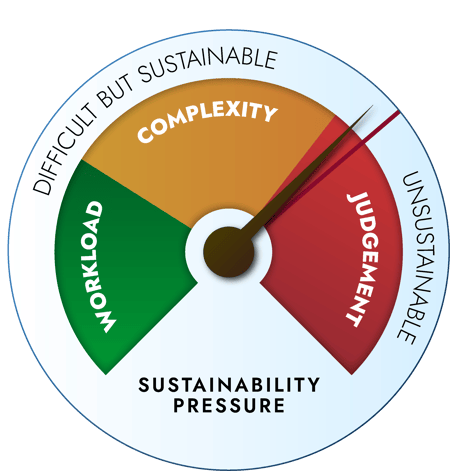
The gauge shows two states. In the first, leadership is demanding but still sustainable. Workload pressure and complexity pressure may both be high, but professional judgement remains intact. The leader still has room to decide what matters, what comes first, and how the work should be adapted to context.
In the second state, judgement pressure is added. The leader remains accountable for outcomes while having less room to adapt, sequence, contextualise, or prioritise. This is where leadership can cross the threshold from demanding to unsustainable.
Workload and complexity make leadership demanding. Judgement pressure is often what makes it unsustainable.
That distinction matters because the solution depends on the diagnosis. Workload pressure may require capacity. Complexity pressure may require coherence. Judgement pressure requires the restoration of professional space.
A leader who misreads judgement pressure as workload pressure will often solve the wrong problem. They may try to become more efficient when the deeper need is greater professional discretion. They may refine their calendar when the deeper issue is the shrinking space to determine what deserves attention. They may assume the solution is better personal management when the real challenge sits in the conditions surrounding the work.
A pattern you cannot name is a pattern you will keep experiencing.
What This Changes
The Sustainability Pressure Gauge changes the conversation because it shows why the same workload can feel different in different conditions. Workload pressure asks us to examine capacity. Complexity pressure asks us to examine coherence. Judgement pressure asks us to examine the relationship between accountability and professional discretion. Each form of pressure requires a different response.
Hargreaves and Fink’s work on sustainable leadership is helpful because it treats sustainability as more than endurance. Sustainable leadership is concerned with preserving the depth, capacity, and conditions that allow leadership to remain effective over time. From that perspective, the question is not simply whether leaders can keep going. The deeper question is whether the work still protects the conditions that allow them to lead well.
The leaders I speak with are seeking the professional space to interpret context, make disciplined decisions, and protect what matters when everything arrives as a priority. They understand that educational leadership is demanding work. Schools carry the hopes, tensions, needs, and aspirations of entire communities. Complexity is part of the role, but complexity becomes harder to sustain when leaders are expected to carry increasing responsibility with decreasing room to exercise judgement.
Sustainable leadership depends not only on what leaders carry. It depends on the professional judgement they retain while carrying it.
Prefer to listen and reflect a little more deeply?
I explore this idea more fully in this week’s podcast episode, where I unpack the research, leadership dynamics, and practical implications in greater depth.
Final Reflection
If leadership feels harder than it did five years ago, the question may not be limited to how much more leaders are carrying. It may also involve how much less room they have to determine what matters, what comes first, and how best to respond to the communities they serve.
That possibility changes the sustainability conversation. It moves the discussion beyond personal resilience, productivity systems, and individual coping strategies. It asks a different question altogether: what conditions are required for good leadership to remain sustainable over time?
Perhaps the question is whether the work still allows leaders to lead.
Sustainable leadership begins when we trust leaders to exercise the judgement we hold them accountable for.
This article explores one idea from my latest leadership paper, The Sustainability Myth. In the full paper, I examine the Judgement–Compliance Gap, Strategic Compliance, and why sustainable leadership depends on protecting the professional judgement that effective leadership requires.
If this conversation resonates with your experience, I invite you to download the full paper and explore the deeper argument.
