
Over the past few years, conversations with school leaders have returned repeatedly to a similar tension. Leaders are working hard to restore stability after a period of extraordinary disruption, while also questioning whether some of the responses developed during that period have unintentionally narrowed what education can become.
The questions are understandable. After significant disruption, every organisation needs to determine what should be restored, what should be protected, and what needs to evolve. For education systems, the COVID-19 pandemic disrupted learning continuity, student wellbeing, assessment practices, and many of the assumptions that had shaped schooling for generations.
Yet alongside those challenges, something else became visible. Schools demonstrated extraordinary adaptive capacity. Teachers redesigned learning experiences, leaders made decisions with incomplete information, and communities found new ways to support students.
The pandemic revealed that schools were capable of greater flexibility than many systems had previously recognised. However, periods of uncertainty also create a powerful organisational instinct: the search for stability.
When complexity increases, people naturally look for what can be clarified, measured, and protected. Organisations seek coherence. Systems seek reliability. Leaders seek ways to reduce unnecessary uncertainty.
This response is understandable. It is also where a deeper tension begins.
The strategies that help a system recover are not always the same strategies that help a system continue developing. A recovery response can become a permanent operating model. A useful priority can become a narrow definition of success. A foundation can become the entire structure.
This is the pattern I describe as the Great Contraction: the movement after disruption when systems understandably move towards what feels essential, measurable, and controllable.
The contraction itself is not the problem. The challenge is recognising when it has served its purpose and when it begins limiting what becomes possible next.
Prefer to watch first?
Here’s the short video version of this week’s idea if you’d like a quicker way into the argument before reading further.
The Great Contraction: When uncertainty changes what systems protect
The pandemic did not create the complexity facing education systems. It exposed it.
For years before COVID-19, schools had already been navigating increasing expectations around student achievement, wellbeing, inclusion, technology, accountability, community engagement, and continuous improvement. The pandemic intensified those conditions and required leaders to make decisions without reliable precedent.
In many ways, the crisis returned leadership to one of its most fundamental responsibilities: judgement. Judgement is the ability to understand a situation, interpret what matters, and determine an appropriate response within a particular context.
Research on complex organisations helps explain why this matters. Weick’s work on sensemaking shows that organisations interpret events and create meaning from them. Those meanings influence what becomes protected afterwards (Weick, 1995). Weick and Sutcliffe’s research on high reliability organisations highlights the importance of remaining attentive to complexity rather than relying on overly simple interpretations of complicated environments (Weick & Sutcliffe, 2015).
After the immediate crisis began to recede, education systems faced another important challenge: recovery.
Students had experienced significant disruption. Learning gaps required attention. Teachers needed support. Communities needed confidence that schools were rebuilding. Recovery efforts appropriately focused on restoring learning, strengthening foundational skills, supporting educators, and building resilient systems.
The deeper issue is what happens after the recovery phase.
Recovery asks what has been lost and what needs to be restored. Education must also ask what students need to become capable of in circumstances that cannot yet be fully predicted.
Foundations matter because they create possibility
This conversation is particularly important when discussing foundational learning.
Educational debates can sometimes create unnecessary divisions between knowledge and capability, literacy and creativity, or achievement and preparation for the future. These are false choices.
Foundations matter because they create possibility. Students cannot think critically without knowledge. They cannot communicate effectively without language. They cannot interpret complex information without the ability to read, analyse, and reason.
This is why literacy and numeracy remain essential priorities. The Australian Curriculum recognises literacy and numeracy alongside critical and creative thinking, personal and social capability, ethical understanding, intercultural understanding, and digital literacy (ACARA, 2022).
The purpose of literacy is not simply improved literacy scores. It allows students to engage with ideas, communicate meaningfully, and participate fully in society. The purpose of numeracy is not simply improved numeracy scores. It allows students to interpret patterns, evaluate evidence, and make informed decisions.
The purpose of foundations is to create the conditions for deeper learning.
The difficulty emerges when the foundation becomes mistaken for the destination.
When improvement becomes narrower than education
Most educational improvement efforts begin with legitimate intentions. Improving literacy matters. Reducing inequity matters. Strengthening teaching quality matters. Supporting student achievement matters.
The challenge is what happens when one important priority gradually becomes the dominant definition of success.
Biesta argues that education has multiple purposes: qualification, socialisation, and subjectification (Biesta, 2015). Students need knowledge and skills, but education also involves participation in communities and the development of individuals capable of independent thought and action.
Some educational purposes are easier to measure than others. Reading performance can be assessed. Mathematical achievement can be compared. Test results can be reported. The development of judgement, agency, curiosity, and responsibility is equally important, but requires deeper interpretation.
During periods of uncertainty, systems naturally move towards what is visible. The measurable becomes easier to manage. Over time, what is measured can become what is prioritised.
This is how educational purpose can narrow without anyone deliberately choosing to narrow it.
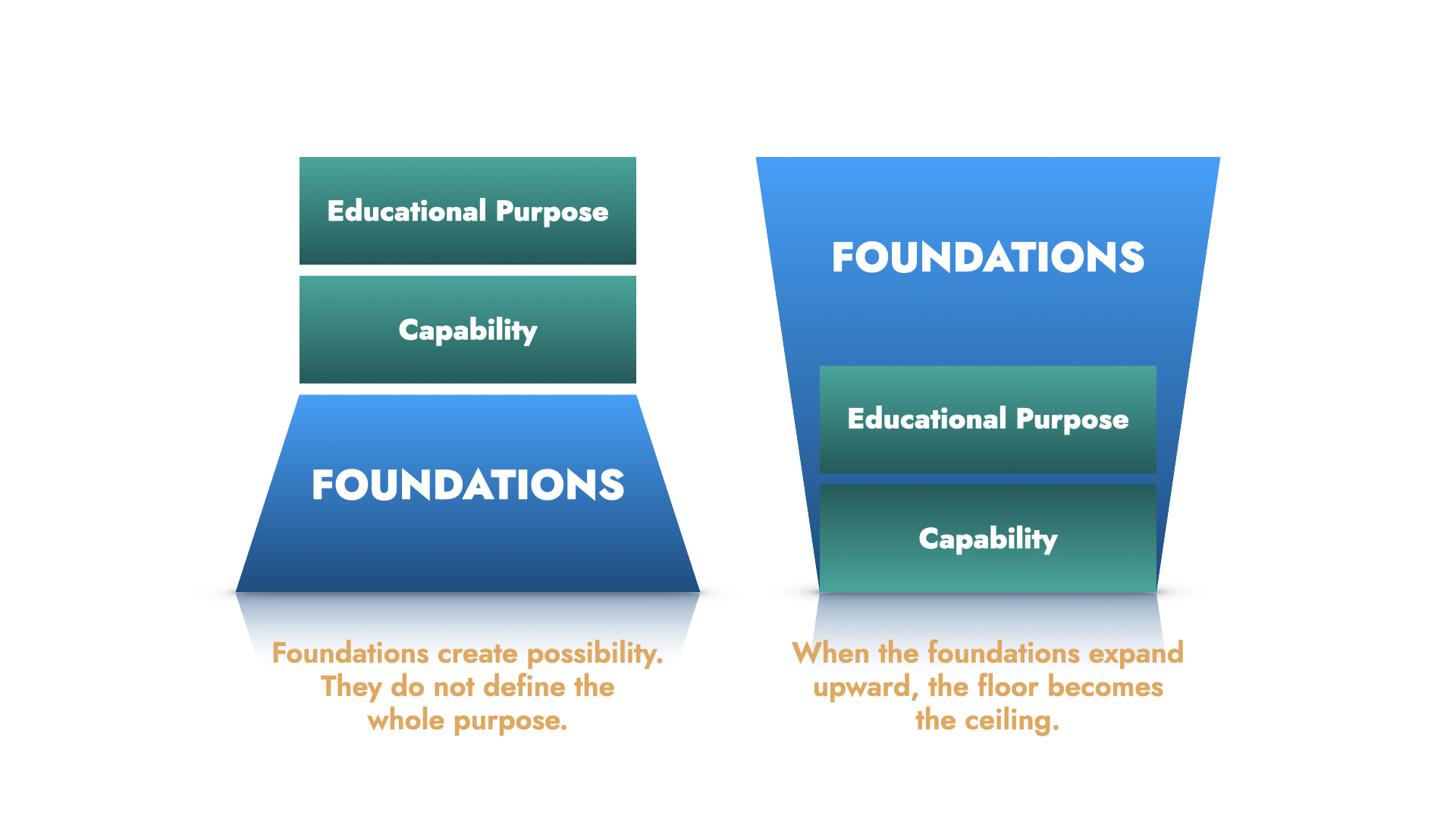
The Foundation–Capability Review
A useful reflection for school leaders is to examine improvement priorities through three connected questions.
What foundation are we strengthening?
What essential knowledge, skills, and understandings are we ensuring every learner develops?
What capability does this foundation enable?
How does this allow students to think, create, communicate, adapt, and contribute?
What broader purpose does this serve?
What kind of learner and person are we helping students become?
These questions do not weaken the importance of foundations. They protect their purpose.
Prefer to listen and reflect a little more deeply?
I explore this idea more fully in this week’s podcast episode, where I unpack the research, leadership dynamics, and practical implications in greater depth.
The floor cannot become the ceiling
Every generation inherits the responsibility of deciding what education should preserve and what education should prepare learners to become.
Students deserve strong literacy. They deserve strong numeracy. They deserve access to the knowledge that allows them to participate fully in society.
They also deserve an education that develops judgement, agency, creativity, relationships, and the capacity to navigate complexity.
The purpose of a foundation has always been to support what comes next.
The floor cannot become the ceiling.
Download the full Leadership Paper: The Sustainability Myth: How Great Leaders Protect What Matters When Everything Is a Priority
