
A quiet contradiction sits inside many conversations about the future of education. We speak with conviction about students needing agency, adaptability, critical thinking, creativity, ethical reasoning, and the capacity to navigate uncertainty. At the same time, many educators and school leaders describe professional environments where the space to interpret, adapt, and exercise judgement is becoming narrower.
The contradiction is not always visible because both sides of it sound responsible. Student agency is promoted because young people will need to make thoughtful decisions in complex environments. System consistency is promoted because education has serious obligations around equity, quality, and public trust. Both aspirations matter, and neither should be dismissed lightly.
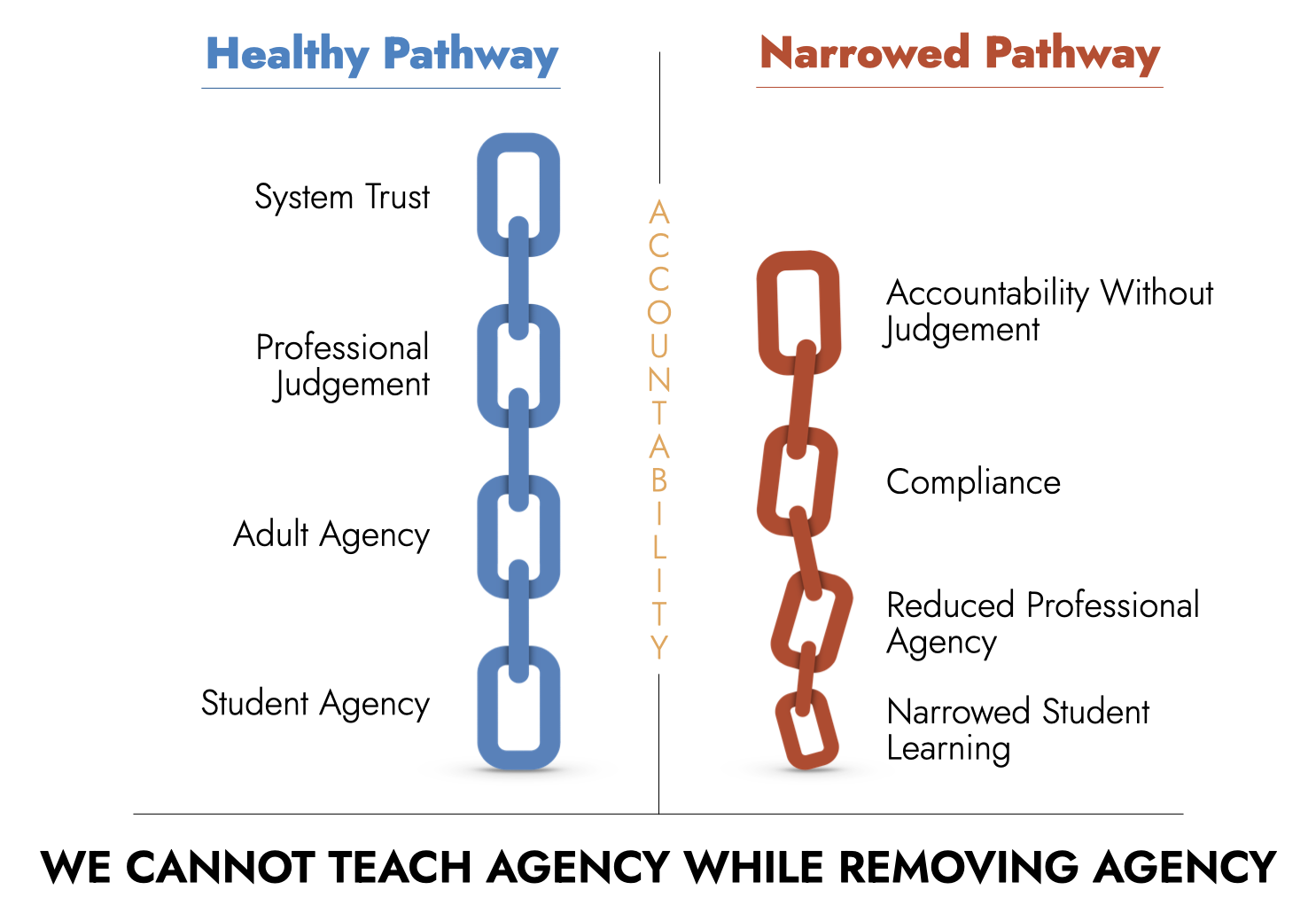
The tension emerges when the professional conditions created for adults no longer resemble the capabilities we hope to develop in students. If students are expected to think critically, educators need professional environments where critical thought is required and valued. If students are expected to exercise agency, leaders need enough agency to shape meaningful responses to the communities they serve. If students are expected to navigate complexity, schools need leaders who are trusted to interpret complexity rather than simply comply with simplified responses.
This is the final argument of The Sustainability Myth. Sustainable leadership is not created by asking capable people to absorb endless demands with more resilience, better organisation, or stronger personal discipline. It is created when leaders retain enough professional judgement to protect what matters, serve local context, and remain accountable for the quality of their decisions.
Prefer to watch first?
Here’s the short video version of this week’s idea if you’d like a quicker way into the argument before reading further.
The Student Agency Paradox
The language of student agency has become familiar across education systems. The OECD Learning Compass 2030 places agency, co-agency, responsibility, and the capacity to create new value at the centre of future-ready education (OECD, 2019). Biesta’s work also reminds us that education is not only about qualification, but also about how young people participate in the world and become capable of independent thought and responsible action (Biesta, 2015).
These ideas have shaped curriculum conversations, future-focused learning agendas, assessment debates, and leadership priorities. Schools are asked to help young people become thoughtful, adaptable, creative, collaborative, and ethically responsible. The aim is not simply for students to know more, but for them to become more capable of using what they know in unfamiliar circumstances.
Yet the adult conditions surrounding this work often move in the opposite direction. More implementation requirements, tighter accountability processes, prescribed approaches, and increasing emphasis on fidelity can leave educators with fewer opportunities to exercise the professional judgement they are expected to cultivate in learners. A system can speak the language of agency for students while reducing agency for the adults responsible for developing it.
The paradox is straightforward: we cannot develop students as thoughtful agents while designing professional environments that treat judgement as a risk to be managed. Agency develops through practice, responsibility, feedback, and trust. The same is true for students, teachers, and leaders.
Professional Judgement Develops Through Use
Professional judgement is not a static trait that leaders either possess or lack. It develops through repeated use inside environments where interpretation is required, decisions carry consequence, and reasoning must be made visible. Schon’s work on reflective practice shows that professional expertise is exercised in complex situations that cannot be solved by technical rules alone (Schon, 1983). Freidson similarly describes professional discretion as central to professional work, because expertise has value only when it can be applied responsibly to particular circumstances (Freidson, 2001).
This matters because judgement cannot be kept in reserve. If a system repeatedly asks leaders only to implement predetermined responses, the system is not strengthening professional judgement. It may strengthen reliability, alignment, and procedural consistency, but it is developing a different capability from the one complex leadership eventually requires.
Schools do not operate in uniform conditions. Communities differ, student needs differ, staff capacity differs, and priorities collide in different ways. Effective leadership therefore depends on the ability to interpret context, weigh consequences, and make decisions that honour system intent while serving local need.
When professional judgement is exercised less often, adaptive capacity can quietly weaken. Leaders may still be committed, skilled, and hardworking, but the environment may be giving them fewer opportunities to practise the very capability it will need when circumstances no longer fit the expected response.
Trust and Accountability Belong Together
One reason professional judgement becomes difficult to discuss is that it is sometimes mistaken for the absence of accountability. That interpretation weakens the conversation. Judgement without accountability can become preference, but accountability without judgement can become performance of compliance.
Robinson’s work on student-centred leadership repeatedly returns leadership attention to impact (Robinson, 2011). The point of professional judgement is not to free leaders from responsibility. It is to help them make better decisions in service of meaningful outcomes, then explain those decisions with evidence, integrity, and professional clarity.
Trust therefore does not mean leaving leaders alone. It means creating conditions where leaders are expected to understand intent, interpret context, make disciplined decisions, and demonstrate impact. Trust and accountability work best when they are treated as partners rather than opponents.
This is also where sustainability becomes more than a workload question. A leader can carry demanding work and remain committed when the work still allows judgement, coherence, and purpose. The work becomes harder to sustain when leaders remain accountable for outcomes while having less room to decide how those outcomes should be achieved.
The Leadership Conditions Students Need
If schools want students to develop agency, educators need professional conditions that model and strengthen agency. That does not mean every decision becomes individual preference. It means the system expects professionals to think, reason, collaborate, adapt, and remain accountable for the quality of their choices.
A useful leadership reflection is to ask where professional judgement is currently being strengthened or constrained. Where are leaders being asked to interpret evidence rather than simply report it? Where are teachers being invited to adapt practice responsibly rather than merely reproduce an approach? Where are teams learning to explain their reasoning, examine impact, and improve decisions over time?
These questions help connect adult professional culture to student learning. Students notice the conditions around them. They learn not only from what adults say about agency and judgement, but from how adults are allowed to practise those capabilities in the life of the school.
A school that values thoughtful learners needs a professional culture where thoughtful adults can lead. That culture requires shared direction, evidence, collaboration, and accountability. It also requires trust in the professional judgement of the people closest to the work.
Prefer to listen and reflect a little more deeply?
I explore this idea more fully in this week’s podcast episode, where I unpack the research, leadership dynamics, and practical implications in greater depth.
Trust Leaders Like We Expect Students to Think
The future of education will not be protected by reducing leadership to implementation. It will be protected by leaders who can think clearly, act responsibly, and explain their judgement in service of learners and communities.
This does not weaken accountability. It restores accountability to its proper purpose. Accountability should help schools improve outcomes, not merely prove that an approved process was followed.
The final question is not whether systems need standards, evidence, consistency, or shared expectations. They do. The question is whether those structures are strengthening professional judgement or replacing it. The conditions that make leadership sustainable are the same conditions that make education worthy of its future: trust, judgement, agency, responsibility, and the courage to protect what matters.
Sustainable leadership begins when we trust leaders to exercise the judgement we hold them accountable for.
Download the full Leadership Paper: The Sustainability Myth: How Great Leaders Protect What Matters When Everything Is a Priority
