Key Takeaways
- Quality student work remains essential, but a polished final product can no longer tell the whole story of learning.
- AI can improve the appearance of student work without necessarily strengthening the thinking behind it.
- Meaningful assessment must uncover the decisions, judgement, revisions, and ownership behind the finished product.
- Explaining a decision, annotating a revision, or evaluating an AI suggestion can reveal authentic understanding.
- One carefully chosen piece of process evidence can be more revealing than additional assignments or assessment tasks.
- The product shows what students created, while the process reveals what they actually learned.
Student products still matter. They are just no longer enough by themselves.
The essay matters. The presentation matters. The design matters. The analysis matters. Quality work still matters. Students should produce work that is accurate, thoughtful, and worth sharing.
The issue is not value. It is burden.
Final products are being asked to prove more than they can reliably prove on their own. In an AI-present world, a polished response may show quality, but it may not show the decisions, judgement, revisions, or ownership that produced it.
Polished completion is easier to produce and harder to interpret.
AI can help students access language, organise ideas, test examples, and improve clarity. Used well, that support can strengthen learning.
But it can also improve the visible product while hiding the learner. A student may submit a stronger paragraph without understanding why it is stronger. They may produce a clearer explanation without evaluating the reasoning. They may create a more sophisticated product without being able to defend the choices behind it.
That means the strongest response is not to distrust every polished product. It is to design better evidence.
Better evidence reconnects the product with the learner.
A student might compare an AI explanation with a trusted source. They might annotate a revision. They might explain why they accepted one suggestion and rejected another. They might defend a final decision in conversation.
This does not make the task heavier by default. It makes the evidence more useful. One well-chosen process trace can help a teacher understand whether the student was reasoning, judging, revising, and taking responsibility.
Think of a product-heavy task your school already uses. A report. A slide deck. A design proposal. A written explanation. Now ask: what one piece of process evidence would make that product more trustworthy as evidence of learning?
Could students explain one decision? Could they annotate one revision? Could they compare one AI suggestion with their final choice? Could they defend the part of the work that matters most?
Product and process belong together. The product gives learning a form. The process helps reveal the learner inside it.
Products still matter. They just cannot carry the whole story alone.
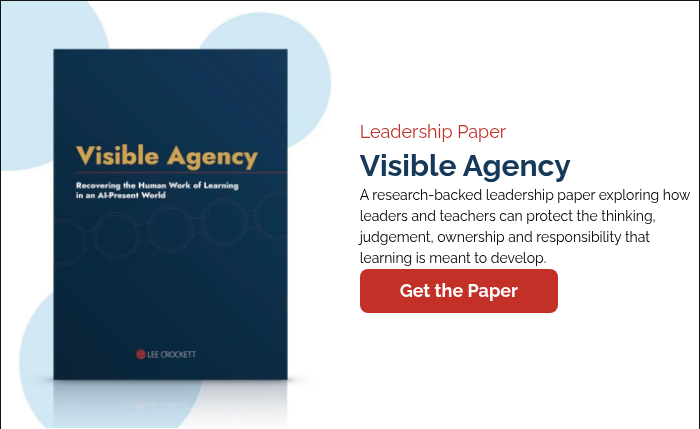
Download the Visible Agency Leadership Paper at https://leecrockett.net/visible-agency.