By the time a task is submitted, it is too late to discover whether the right human capabilities were designed into the learning. This is one of the most important leadership implications of Visible Agency. The evidence teachers receive at the end is not accidental. It is shaped by the decisions made at the beginning: what the task required, what the criteria named, what students were asked to explain, what support was permitted, what process was visible and what kind of thinking the design made necessary.
This matters because schools often look for evidence of capability after the work has already been completed. A team may ask whether students showed judgement, agency, collaboration, creativity or ownership when the final products are on the table. Sometimes the evidence is there. Sometimes it is not. But when it is missing, the problem may not be student effort alone. The design may never have required the capability to become visible.
Week 6 moves the campaign from evidence recognition to design discipline. Week 5 named the five traces of student thinking: questions, choices, judgements, revisions and ownership. Week 6 asks how those traces get designed into learning in the first place. The answer is the Evidence-Rich Design Chain.
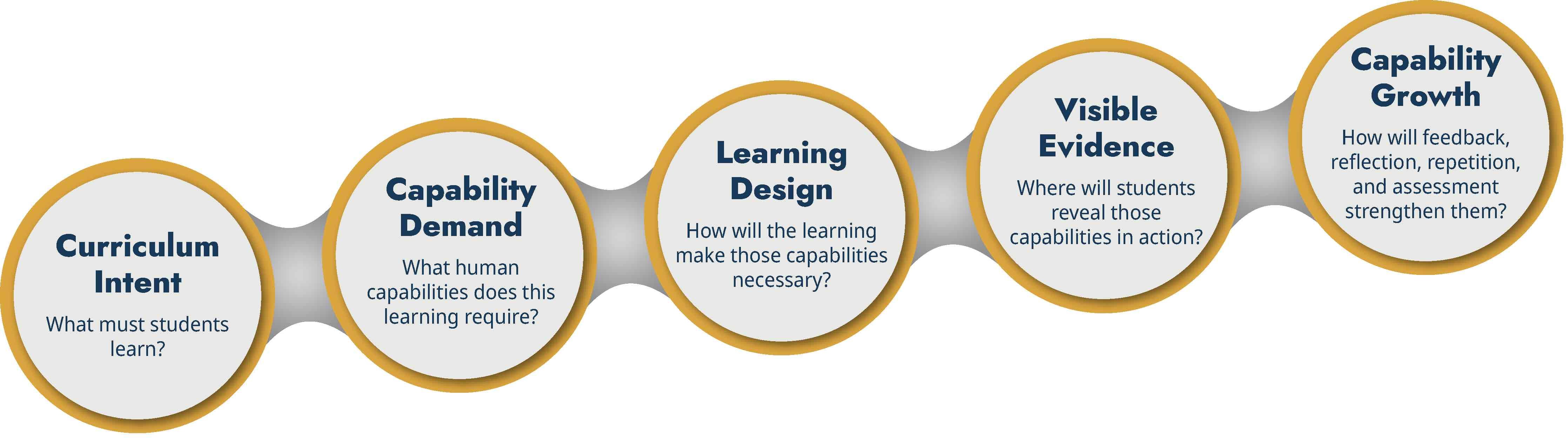
The chain is simple: curriculum intent, capability demand, learning design, visible evidence, feedback and growth. It gives leaders and teachers a way to move from what the curriculum requires to what students must become more capable of doing, and then to the evidence that will make that capability visible.
Prefer to watch first?
Here is the video version of this week's idea.
Start With Curriculum Intent
Evidence-rich design does not begin by adding reflection prompts to an existing task. It begins with curriculum intent. What is the learning meant to help students understand, practise or use? What knowledge matters? What concepts are central? What skills or standards are genuinely being developed?
This starting point matters because Visible Agency is not an argument against knowledge, explicit teaching, practice or rigour. Students cannot exercise judgement about nothing. They cannot revise thinking they have not developed. They cannot take ownership of a product that has no meaningful content or purpose. Human capability grows through engagement with knowledge, discipline, criteria and worthwhile work.
A task becomes weak when the curriculum intent is vague. If teachers cannot name the intellectual purpose of the learning, the process evidence will also become vague. Students may produce something, but the human capability behind the work remains difficult to interpret. The first link in the chain is therefore clarity about what the learning is for.
For leaders, this is reassuring because it keeps the conversation anchored in the real work of schooling. Evidence-rich design is not an extra initiative floating beside curriculum. It is a way of asking more precise questions about curriculum design. What does this learning require students to understand, and what should they become more capable of doing with that understanding?
Name The Capability Demand
The second link is capability demand. This is where many tasks become thin. A team may know what content will be taught, what activity students will complete and what product will be submitted, but the capability demand remains implied. Teachers may assume the research task requires discernment, the project requires collaboration, the essay requires judgement, or the presentation requires ownership. Sometimes that assumption is fair. Often it is incomplete.
Capability demand asks: what human capability must students actually practise here? Are they comparing evidence? Weighing alternatives? Revising a claim? Making a design decision? Testing accuracy? Explaining uncertainty? Taking responsibility for quality? If the answer is unclear, the task may still be organised, but it is not yet evidence-rich.
This is where the Human Capability Blind Spot narrows. Schools already value capabilities such as critical thinking, creativity, collaboration, ethical understanding, learner agency and self-regulation. These ideas appear in curriculum frameworks, strategic plans and graduate profiles. The problem is not that the language is absent. The problem is that the language is often not connected tightly enough to task design.
The OECD Learning Compass frames future-ready learning around knowledge, skills, attitudes, values and agency (OECD, 2019). The Australian Curriculum describes general capabilities as developed through learning area content, not as separate decorative additions. The leadership question is therefore practical: where does this capability become necessary in the learning?
Design The Learning So The Capability Is Required
The third link is learning design. Once the capability demand is clear, the task has to require it. This is the difference between naming judgement and designing for judgement. It is the difference between valuing ownership and requiring students to stand behind decisions. It is the difference between hoping students will think and creating conditions where the work cannot be completed well without thinking.
In an AI-present world, this becomes urgent. A task that only asks for a final product may allow AI to do too much of the visible work. A task that requires comparison, explanation, revision, verification or defence makes the learner's role harder to outsource. AI may still support the process, but the student must remain active inside it.
This does not mean every task needs to become complex. Often one design move is enough. Ask students to compare two possible explanations before choosing one. Ask them to annotate the revision that changed the quality of the work. Ask them to identify one AI suggestion they rejected and why. Ask them to defend the final claim orally. Ask them to connect a decision to evidence, criteria or audience.
The design move should fit the capability demand. If the capability is discernment, the task should require students to evaluate. If the capability is metacognition, the task should require students to notice how their thinking changed. If the capability is ownership, the task should require students to explain and defend the final work.
Decide What Evidence Will Be Visible
The fourth link is visible evidence. This is where the chain protects teachers from unnecessary workload. Evidence-rich design does not ask teachers to collect everything. It asks them to decide what evidence would reveal the capability that matters.
If the capability demand is judgement, the evidence might be a comparison note, a source check, a rejected suggestion or a brief explanation of criteria. If the capability demand is revision, the evidence might be a marked change and a sentence explaining why it improved the work. If the capability demand is ownership, the evidence might be an oral defence or a written statement of responsibility.
The evidence should be proportional. A major project may need richer evidence than a short classroom activity. A high-stakes assessment may need more transparency than a practice task. A task with substantial AI support may need clearer process evidence than a task where AI is not relevant. The point is not volume. The point is usefulness.
This connects directly to formative assessment research. Evidence becomes educationally powerful when it is elicited, interpreted and used to shape next steps (Black & Wiliam, 1998). Evidence that simply proves activity occurred may satisfy a reporting need. Evidence that reveals student thinking can strengthen learning.
Use Evidence For Feedback And Growth
The final link is feedback and growth. Visible evidence only matters if it changes the learning conversation. Teachers should be able to use the evidence to give more precise feedback. Students should be able to use it to understand their own process. Leaders should be able to use it to ask better questions about the quality of learning design.
A student's process note might show that they asked a weak question before using AI. That becomes feedback about inquiry. A rejected suggestion might show strong discernment. That becomes feedback about judgement. A revision explanation might reveal that the student improved the language but not the reasoning. That becomes feedback about depth. An ownership defence might show that the student can present the final product but cannot yet explain the evidence behind it. That becomes feedback about responsibility.
This is the practical power of the chain. It connects design to evidence and evidence to improvement. It helps teachers see what to strengthen next. It helps students become more aware of how they learn. It helps leaders move beyond general encouragement and into focused professional conversations.
A Leadership Tool, Not A Template
The Evidence-Rich Design Chain should not become another form to complete. Its value is in the conversation it creates. It helps teams slow down at the right point. Before the task is taught, before AI use becomes a source of uncertainty, before the final products arrive, teachers can ask whether the design will show what matters.
A leadership team might use the chain in a planning meeting. A faculty might use it to review one common assessment. A professional learning community might use it to redesign a task that produces polished products but weak evidence of thinking. A coach might use it in conversation with a teacher who wants students to use AI responsibly without losing the learning demand.
The chain works because it respects the complexity of teaching. It does not prescribe one method. It asks a disciplined sequence of questions. What is the curriculum intent? What capability does this learning require? How will the design make that capability necessary? What evidence will reveal it? How will that evidence support feedback and growth?
Closing Reflection
The evidence schools want at the end has to be designed at the beginning. This is the discipline Week 6 adds to the campaign. Visible Agency is not only about noticing what is missing after student work is submitted. It is about designing learning so the human work is less likely to disappear in the first place.
The Evidence-Rich Design Chain gives leaders a practical way to protect that work. It connects curriculum to capability, capability to design, design to evidence, and evidence to growth. It helps schools ask not only what students will produce, but what the production of the work will require them to think, judge, revise and own.
That is how the Human Capability Blind Spot begins to narrow. Not through more documentation, but through better design.
Prefer to listen and reflect more deeply?
This week's podcast explores how leaders can use the Evidence-Rich Design Chain without turning it into another compliance process.
Leadership Application
The most useful way to introduce the Evidence-Rich Design Chain is through a task teachers already care about. Leaders do not need to begin with a whole-school redesign. They can begin with one assessment, one common unit, one year-level task or one professional learning conversation where the evidence currently feels thin.
A leadership team might ask each faculty to bring one task that produces completed work but leaves uncertainty about student thinking. The task does not need to be broken. In fact, the best starting points are often tasks that look successful on the surface. The question is not whether the task is good or bad. The question is what human capability it makes visible.
From there, the chain gives the conversation order. First, what is the curriculum intent? Second, what capability should students become more able to demonstrate? Third, where does the design require that capability? Fourth, what evidence will reveal it? Fifth, how will that evidence improve feedback or growth?
This sequence helps teams avoid the common trap of adding process evidence after the task is already designed. If teachers simply attach a reflection at the end, the reflection may become disconnected from the real learning. Evidence-rich design asks teams to build the evidence into the task itself, so students make the important thinking visible while the learning is happening.
For leaders, this also creates a better professional learning rhythm. Instead of announcing a new AI initiative, leaders can ask teams to study one design decision. What did the task make visible? What remained hidden? What would we change next time so the evidence is sharper and lighter? That kind of conversation builds capacity without turning Visible Agency into another program.
Using The Chain Without Turning It Into A Form
The Evidence-Rich Design Chain is most useful as a conversation before it becomes a document. This matters because schools have a habit of turning good professional questions into templates too quickly. A template can help once the thinking is clear, but if it arrives too early it can reduce design work to compliance.
Leaders should introduce the chain through existing planning routines. In a faculty meeting, a team might bring one task and talk through the five links together. What is the curriculum intent? What capability should students strengthen? Where does the task require that capability? What evidence will reveal it? How will that evidence improve feedback or growth?
That conversation is the work. The value is not in producing a polished planning sheet. The value is in helping teachers see where the design currently makes capability visible and where it leaves too much to assumption. Over time, the questions become part of the school's design culture.
This also protects teacher workload. Evidence-rich design should reduce uncertainty, not increase documentation. If a proposed evidence point does not help the teacher give better feedback or help the student understand their learning, it should be questioned. The chain is not asking for more artefacts. It is asking for better alignment between the learning purpose and the evidence collected.
A Backward Design Example
Imagine a team reviewing a Year 9 science investigation. The curriculum intent is not only that students learn the relevant concept, but that they use evidence to support a claim. The capability demand is therefore judgement: students need to judge whether their evidence is strong enough, whether the claim is accurate, and whether alternative explanations need to be considered.
If the task only asks for a final report, the teacher may see the product but not the judgement. The team can then redesign one point in the process. Students might compare two possible claims and explain which one is better supported. They might identify one piece of evidence that is weak or uncertain. They might use AI to generate a possible alternative explanation and then evaluate whether it fits the data.
The visible evidence could be small: a short comparison note, a highlighted claim, or a conference response. The feedback can then focus directly on the quality of student judgement. The task has not become larger for the sake of being larger. It has become more evidence-rich because the capability demand is now visible.
That is the chain at work. It turns the question of AI and learning from a general concern into a design sequence teachers can use.
Download the full Leadership Paper: Visible Agency: How to Design AI-Supported Learning Without Outsourcing Student Thinking