A teacher recently described a pattern that many schools will recognise. Students were using AI to improve their work, and the improvement was real. Drafts became clearer. Explanations became more fluent. The structure became easier to follow. Yet when students were asked what had changed in their thinking, many could only describe what had changed in the product.
That distinction matters. AI can help students produce better work without necessarily helping them understand their own learning more deeply. It can also do the opposite. Used well, AI can become a powerful mirror for thinking. It can help students test assumptions, compare explanations, identify gaps, review a draft, question a claim, plan next steps and notice the difference between surface improvement and deeper understanding.
Week 7 of Visible Agency focuses on metacognition because it sits at the centre of responsible AI-supported learning. If students are going to use powerful support, they need to become more aware of how they are thinking with that support. They need to know what they asked, what they noticed, what changed, what improved and what they now understand more clearly.
Metacognition becomes more important, not less, when AI is available. The learner needs to understand the movement of their own thinking, not merely the improvement of the final product.
Prefer to watch first?
Here is the video version of this week's idea.
The Shortcut Risk
The shortcut risk is not only that students will ask AI to do the work. It is that students may use AI to move past the very moments where learning would have become visible. A difficult explanation becomes smoother before the student has noticed why it was weak. A vague plan becomes organised before the student has understood the structure. A shallow claim becomes more persuasive before the student has tested the evidence.
When this happens, the final product may improve while metacognition remains thin. Students can describe the tool's contribution but not their own learning. They can say that AI helped them make it better, but they cannot explain what better means, what changed, or what they understand now that they did not understand before.
This is why schools need to distinguish between product improvement and thinking improvement. Product improvement is visible in the final work. Thinking improvement is visible when students can describe the change in understanding, strategy, judgement or self-awareness that occurred through the process.
The danger is not AI support itself. Students have always learned with support: teachers, peers, examples, feedback, resources, models, assistive tools and family help. The educational question is whether support helps learners become more capable or simply helps them arrive at a better-looking endpoint.
The Metacognitive Opportunity
AI can strengthen metacognition when it is used as a prompt for reflection rather than a substitute for reflection. It can help students compare their first thinking with another explanation. It can ask them to identify assumptions. It can generate questions they had not considered. It can help them test whether their reasoning is clear. It can offer feedback that students then have to evaluate.
This aligns with the broader research on metacognition and self-regulated learning. Students learn more effectively when they are supported to plan, monitor and evaluate their learning, especially when those processes are taught within meaningful subject tasks rather than as generic reflection exercises (Education Endowment Foundation, 2025; Zimmerman, 2002).
In AI-supported learning, planning might involve students naming what they are trying to understand before using AI. Monitoring might involve students checking whether the support is helping or distracting from the learning purpose. Evaluating might involve students explaining what changed in their thinking after feedback, comparison or revision.
The point is not to ask students to write long reflections. The point is to make metacognition part of the work. AI can support that if the task asks students to notice the relationship between the tool's suggestion and their own thinking.
AI As A Thinking Mirror
One useful way to frame AI is as a thinking mirror. A mirror does not do the work of becoming for us. It helps us see something more clearly. AI can serve that role when students use it to reflect on the quality of their thinking.
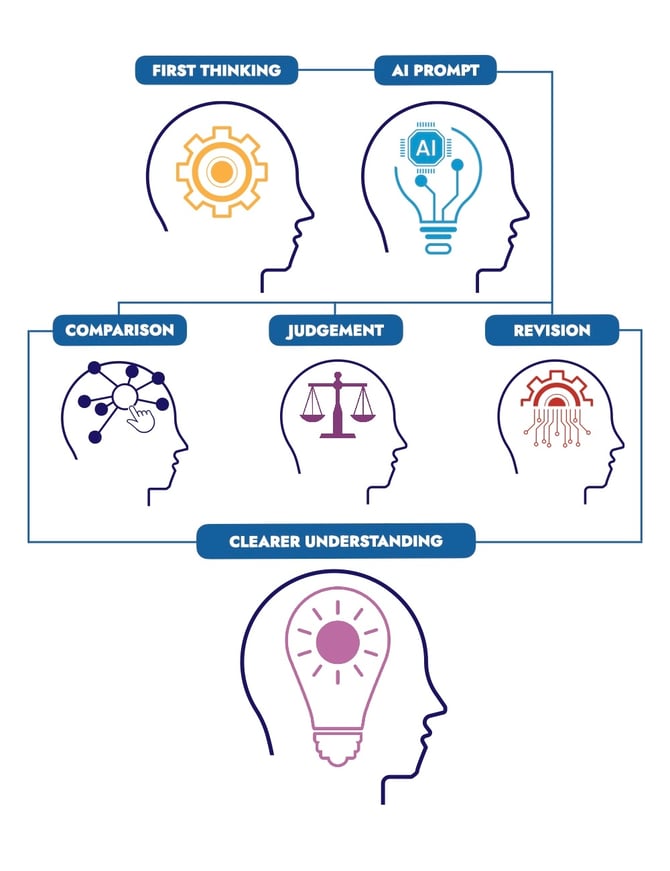
A student might paste a draft and ask, what assumption does this argument rely on? They might ask for two possible counterarguments, then decide which one exposes the weakest part of their reasoning. They might ask AI to explain a concept in a different way, then identify which explanation fits their current understanding and why. They might ask for feedback on clarity, then decide which feedback is accurate and which is too general.
In each case, the learning sits in the student's response to the support. The tool creates a possibility for comparison. The student still has to judge, revise and own the next move.
This is a different use of AI from simple completion. It treats AI as a way to make thinking more visible. Students see their ideas beside alternatives. They notice gaps. They hear a different formulation. They encounter a question they had not asked. They are invited to examine their own reasoning.
Revision As Metacognitive Evidence
Revision is one of the strongest places to see metacognition because it shows whether students understand the purpose of improvement. In AI-supported learning, a student may receive suggested edits quickly. The metacognitive question is whether they understand which edits mattered and why.
A useful revision prompt might ask: what changed between your first version and final version, and what do you understand more clearly because of that change? Another might ask students to identify one AI suggestion they accepted, one they rejected and one they modified. A third might ask students to explain which revision improved the thinking, not just the wording.
These prompts do not need to be burdensome. They simply require students to connect improvement to awareness. When students can explain why a revision mattered, they are showing more than compliance. They are showing that they monitored quality and evaluated change.
This is where AI-supported learning can become more powerful than traditional drafting alone. Students can receive more feedback, more quickly. But the design has to require them to think about the feedback. Otherwise, speed may replace reflection.
What Leaders Should Ask Teams
Leaders do not need to mandate a universal AI reflection form. That would likely create more compliance than metacognition. The stronger move is to help teams ask better design questions.
Where in this task do students plan before using support? Where do they monitor whether the support is helping? Where do they evaluate what changed? Where do they explain the difference between product improvement and thinking improvement? Where do they show what they now understand more clearly?
These questions connect Week 7 back to the Evidence-Rich Design Chain. If metacognition is the capability demand, the learning design must require planning, monitoring or evaluation. The visible evidence might be brief: a before-and-after note, a revision explanation, a rejected suggestion, an oral conference, or a single sentence naming the shift in understanding.
The aim is not to make reflection performative. The aim is to make students more conscious of how they learn with support. AI-supported learning should not make students less aware of their thinking. It should give them better opportunities to see it.
Closing Reflection
Metacognition is not an optional extra in an AI-present world. It is one of the ways students remain visible inside the learning. When support becomes more powerful, students need stronger awareness of how that support affected their thinking.
The question is not simply whether AI helped the work improve. The question is whether students can explain what improved in their understanding, strategy, judgement or responsibility. That is the evidence that metacognition is present.
AI should help students notice their thinking, not move around it. It should help them test ideas, compare possibilities, evaluate feedback and revise with intention. When that happens, AI-supported learning can deepen the human work rather than replace it.
Prefer to listen and reflect more deeply?
This week's podcast explores how leaders can help teams use AI as a metacognitive support rather than a shortcut.
Leadership Application
For leaders, the metacognition question is also a culture question. What do students in this school learn to pay attention to when they receive support? If the ordinary message is only to finish, submit and move on, AI will accelerate completion without necessarily strengthening awareness. If the ordinary message is to notice how thinking changes, AI can become part of a more reflective learning culture.
This does not require every teacher to teach metacognition in the same way. A science teacher may ask students to explain how their hypothesis changed after feedback. An English teacher may ask what revision strengthened the reasoning rather than the wording. A design teacher may ask which constraint became clearer after testing an idea. A mathematics teacher may ask students to compare two solution pathways and explain what each revealed.
The common thread is not the prompt itself. The common thread is the expectation that students can notice the movement of their own thinking. That expectation becomes more important when AI is available because the tool can hide the movement. It can move students from uncertainty to fluency quickly, and fluency can feel like understanding before it has earned the name.
Leaders can support teams by keeping the evidence small and purposeful. Ask for one metacognitive moment, not a long reflection. Ask for the shift in understanding, not a diary of every action. Ask students to name what they understand more clearly now, and connect that answer to the quality of the work.
When schools do this consistently, metacognition becomes less performative. It becomes part of how students learn to use support responsibly. They begin to see AI not as a way around thinking, but as something they must think with, question and learn from.
The Difference Between Reflection And Metacognition
One reason metacognition can become weak in schools is that it is confused with reflection. Reflection may be useful, but not every reflection is metacognitive. A student can write a thoughtful-sounding paragraph at the end of a task without revealing much about how they planned, monitored, evaluated, or changed their thinking.
Metacognition is closer to the learning itself. It asks students to notice what they were trying to do, how well their strategy was working, what feedback or support helped them see, what needed to change, and what they now understand more clearly. In AI-supported learning, this distinction matters because AI can help students produce reflective language without necessarily making them more aware of their thinking.
A generic reflection asks, how did you feel about the task? A metacognitive prompt asks, what did you understand more clearly after comparing your draft with the feedback? A generic reflection asks, what did you learn? A metacognitive prompt asks, what changed in your explanation, and why did that change improve the reasoning? The second kind of question is harder to answer without real awareness.
This is why leaders should be careful about adding reflection requirements as a quick safeguard. Long reflections can become another product. Metacognitive evidence should be closer to the moment where thinking changed. It should help students see the movement of learning, not simply describe the experience after the fact.
Designing AI As A Thinking Partner
When AI is used well, it can help create metacognitive friction. It can give students something to compare against, question, test, or reject. The task design determines whether that friction strengthens learning or disappears into passive acceptance.
A student might ask AI for feedback on an explanation, but the metacognitive move is deciding which feedback actually improves the reasoning. A student might ask for a counterargument, but the learning is in judging whether the counterargument is fair. A student might ask for a clearer structure, but the metacognition is in explaining why that structure makes the idea easier to understand.
The leader's role is to help teams design these moments deliberately. Where will students pause before accepting support? Where will they compare the output with criteria? Where will they explain the change in understanding? Where will the teacher see whether the student became more aware of their thinking?
These are small design choices, but they have large implications. If students learn that AI is simply a way to make work smoother, metacognition weakens. If they learn that AI can be used to examine, test, and improve their thinking, metacognition becomes stronger. That is the Week 7 opportunity.
Download the full Leadership Paper: Visible Agency: How to Design AI-Supported Learning Without Outsourcing Student Thinking