A pattern I have seen in many schools is that leaders and teachers can speak clearly about the capabilities they value. They want students to think critically, act with agency, collaborate thoughtfully, use judgement, revise with care, and take ownership of learning. The aspiration is usually not the problem.
The problem is visibility.
Schools may value these capabilities while still relying on evidence that does not show them clearly. A completed task may suggest responsibility without showing ownership. A strong answer may suggest understanding without showing judgement. A group product may suggest collaboration without showing how thinking changed through the work. A polished response may suggest capability while hiding the decisions that produced it.
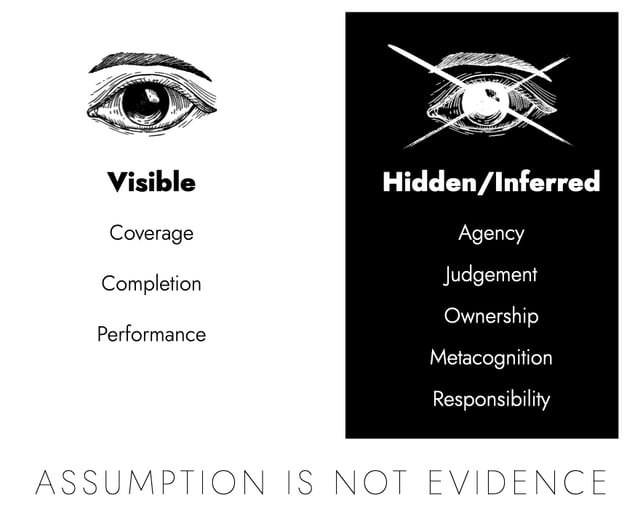
This is the Human Capability Blind Spot: the condition that appears when schools can see coverage, completion, and performance more clearly than the human capabilities they most want students to develop.
The blind spot is easy to miss because schools are rarely indifferent to human capability. Most schools are not saying that agency, judgement, ownership, metacognition, and responsibility do not matter. They often say the opposite. These ideas appear in strategy documents, curriculum frameworks, graduate profiles, learning dispositions, and professional conversations.
The difficulty is that valuing a capability is not the same as seeing it. Seeing it is not the same as strengthening it. Strengthening it requires evidence that is clear enough to teach from, give feedback on, and discuss with students.
Prefer to watch first?
Assumption Is Not Evidence
The Human Capability Blind Spot is not caused by lack of care. It often appears in schools that care deeply about learning. Leaders name agency in strategic plans. Teachers design rich tasks. Curriculum documents include general capabilities. Yet when teams ask what evidence they actually have, some of the most important human work is still being inferred.
That word matters: inferred. Inference is part of teaching. Teachers constantly make professional judgements from incomplete information. But when the capabilities we most value are mostly inferred, they become harder to teach deliberately. They remain admired but under-examined.
A student who submits a strong project may have shown ownership, or they may have followed directions well. A student who contributes in a group may have collaborated thoughtfully, or they may have completed an assigned portion without engaging deeply with others' thinking. A student who turns in a polished essay may have exercised judgement, or they may have accepted a fluent structure without understanding why it works.
The point is not to distrust the student. The point is to improve the evidence. Assumption is not evidence.
Formative assessment research helps clarify the issue. Learning evidence becomes powerful when it is visible enough to guide feedback and next steps (Black & Wiliam, 1998). If a capability remains hidden, teachers may value it but struggle to teach, discuss, or strengthen it deliberately.
Metacognition research points in the same direction. Students become more effective learners when they learn to plan, monitor, and evaluate their thinking (Education Endowment Foundation, 2025). But those processes need to become visible in the learning experience. If they remain private, accidental, or added only after the work is complete, they are harder to develop with intention.
Better Evidence, Not More Evidence
The answer is not to bury teachers or students in documentation. That would miss the point. Visible Agency is not asking schools to record every thought, prompt, draft, or decision. It asks schools to identify the few moments where human capability matters most and make those moments visible enough to improve learning.
This distinction is crucial. More evidence can make learning heavier without making it clearer. Better evidence makes the right learning visible at the right moment. A short explanation can reveal judgement. A brief comparison can reveal discernment. A revision note can reveal metacognition. A defence of a final choice can reveal ownership.
For example, a student might be asked to identify one AI suggestion they rejected and explain why. That small move may reveal more judgement than a page of generic reflection. Another student might annotate two revisions and explain how they improved meaning. That may reveal more metacognition than a final paragraph about effort. A third student might defend the source they trusted most in a research task. That may reveal ownership of reasoning in a way the finished report cannot.
The Human Capability Blind Spot begins to close when schools stop assuming that capability is present simply because the product is complete. Capability becomes teachable when it becomes visible.
What Leaders Can Ask Without Creating Another Burden
Leaders do not need to begin with a new system. They can begin with a better question in existing planning and review conversations: what important capability are we currently inferring rather than evidencing?
That question can be asked at the level of a task, a unit, a year level, or a whole-school priority. If the school values student agency, where does agency become visible? If it values judgement, where do students explain how they judged quality, accuracy, relevance, or usefulness? If it values ownership, where do students show that they understand and stand behind the final work?
The best answers are usually small and specific. A team does not need to redesign everything. It might identify one place in a task where students must explain a decision. It might add one comparison step before a final product. It might ask students to annotate one meaningful revision. It might include a short oral check where students explain what they understand without leaning on the product.
These moves matter because they change the learning conversation. Teachers can give feedback on the quality of judgement, not only the quality of the product. Students can become more aware of their decisions, not only their completion. Leaders can see whether the capabilities they value are actually being practised.
Prefer to listen and reflect a little more deeply?
Closing Reflection
The Human Capability Blind Spot is powerful because it gives leaders language for something many already recognise. Schools may be rich in evidence and still thin in the evidence that matters most for human capability.
The next step is not to collect everything. It is to make the right moments of learning visible enough to teach, strengthen, and discuss. Visibility is not the whole answer, but it is the discipline that allows capability to become more than an aspiration.
Why The Blind Spot Persists
The Human Capability Blind Spot persists because the evidence schools can collect most easily is not always the evidence that matters most. Completion is easy to see. Marks are easy to record. Attendance, submission, grades, rubrics, pacing charts, and moderation samples all create a visible system. Agency, judgement, ownership, metacognition, and responsibility are more difficult to see because they live inside decisions students make during the learning.
This does not mean schools should abandon visible system evidence. It means leaders need to recognise its limits. A school can become extremely organised around evidence that is convenient while remaining underdeveloped around evidence that reveals human capability. That is not a moral failure. It is a design problem.
The blind spot is also sustained by language. Schools often use capability words generously. They say students are developing agency, thinking critically, collaborating, reflecting, innovating, and taking ownership. Those words can be true, but they need evidence. If the words appear mainly in strategic plans and promotional language, they remain aspirational. If they appear in task design, student explanation, feedback, moderation, and review, they begin to become teachable.
This is why Week 3 matters in the campaign arc. It gives leaders permission to name the gap without blaming teachers or students. The problem is not that people do not care about human capability. The problem is that the system may not yet be designed to see it clearly.
What Closing The Blind Spot Looks Like
Closing the blind spot begins with one capability and one task. If a school says it values judgement, choose a task where judgement should matter. Then ask where the student has to show how they judged quality, accuracy, relevance, fairness, or usefulness.
If the answer is nowhere, the task may still produce work, but it will not produce strong evidence of judgement. The fix may be small. Students might compare two sources and explain which one they trust more. They might evaluate an AI-generated answer against a criterion. They might identify one limitation in their own work and revise it. The visible evidence does not need to be large, but it needs to reveal the capability.
If a school says it values ownership, choose a task where students submit a final product. Then ask where students have to stand behind the final meaning. Can they explain the decision that mattered? Can they defend the evidence? Can they show what they changed? Can they describe what support helped with and what responsibility remained theirs?
These questions help schools move from capability as aspiration to capability as evidence. They also help students. When students know which capability is being made visible, they begin to understand learning as more than finishing. They learn that their questions, choices, judgements, revisions, and ownership are part of the work.
That is the discipline Visible Agency is trying to build. Not more noise. Clearer evidence of the human work schools already value.
Download the full Leadership Paper Visible Agency: How to Design AI-Supported Learning Without Outsourcing Student Thinking