One of the conversations I have found myself having repeatedly with school leaders begins with a deceptively simple question: how do we know the student did the thinking? It usually does not come from panic. It does not always come from suspicion. More often, it arrives in the quiet moment after a teacher has read work that is fluent, well organised, and difficult to interpret as evidence of learning.
The work looks successful. The paragraphing is clear. The vocabulary is more confident than expected. The task has been completed and submitted on time. Nothing in the product necessarily looks wrong. Yet the teacher is still left holding a question that did not use to feel quite so urgent: what part of this work reveals what the learner actually did?
That question matters because schools have long treated student work as a practical proxy for student learning. A written response suggested reading, interpretation, structure, revision, and communication. A research task suggested searching, selecting, comparing, evaluating, and synthesising. A presentation suggested preparation, understanding, and the ability to communicate ideas to others. These assumptions were never perfect, but they were often useful enough to support feedback, assessment, reporting, and professional judgement.
AI has changed the conditions around those assumptions. Students can now receive help with planning, drafting, summarising, translating, reorganising, editing, generating examples, checking clarity, and polishing the visible surface of their work. Some of that help can be valuable. It can make learning more accessible, help students see possibilities, provide feedback in the moment, and support students who might otherwise struggle to get started. The problem is not that support exists. The problem is that the final product may no longer show enough of the human work that gave the product its educational value.
This is the opening question of Visible Agency: what can student work still prove by itself?
Prefer to watch first?
Here’s the short video version of this week’s idea if you’d like a quicker way into the argument before reading further.
The Product Can No Longer Carry the Whole Story
Schools should still care about the quality of student products. A weak final product is not automatically evidence of deeper learning, and a strong final product should not be dismissed simply because AI may have supported it. Students still need to produce clear explanations, accurate analyses, thoughtful designs, persuasive arguments, useful prototypes, and careful performances. Standards matter because learning should eventually become visible in work that has quality.
The issue is that quality alone can no longer carry the whole story. A polished explanation may not reveal whether the student understood the concept before the language was improved. A persuasive paragraph may not show whether the student selected the evidence, weighed alternatives, or simply accepted a fluent suggestion. A slide deck may look organised without showing whether the student identified the structure or inherited it from a tool. A reflection may sound thoughtful without showing whether much reflecting actually happened.
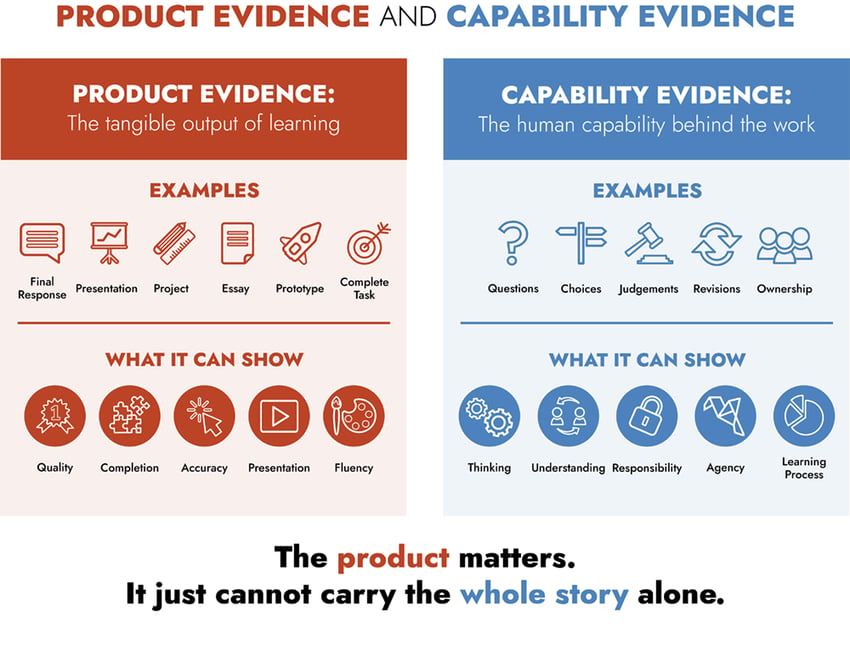
This creates a subtle but important leadership challenge. If schools respond by distrusting every polished product, the professional conversation becomes narrow and defensive. If schools respond by pretending nothing has changed, the evidence base becomes fragile. The stronger response is neither suspicion nor denial. It is a more disciplined understanding of what different forms of evidence can and cannot show.
Completion tells us that something was produced. Quality tells us something about the visible standard of that product. Neither one, by itself, always tells us what the learner noticed, questioned, judged, revised, understood, or came to own. When AI can improve the surface of the work quickly, schools need stronger ways to see the learning underneath the surface.
That does not mean teachers need to document every step of a student's process. It does not mean learning should become surveillance. It means the most important moments of thinking need to become visible enough to discuss. The human work may be in the question a student asks before using support, the choice they make between two possible explanations, the revision they can justify, the limitation they notice in an AI suggestion, or the part of the final work they are prepared to defend without the tool beside them.
The product still matters. It just cannot carry the whole story alone.
AI Did Not Create the Evidence Problem
One reason this moment feels unsettling is that AI has exposed a truth schools were already living with. Final products have always been partial evidence. A correct answer has never guaranteed understanding. A strong essay has never revealed every decision behind the argument. A completed project has never shown every misconception that was resolved, avoided, or hidden. Teachers have always had to interpret the relationship between the visible work and the learning that produced it.
What AI changes is the reliability of the inference. Teachers used to be able to infer a fair amount from the struggle, structure, fluency, and quality embedded in student work. Now some of those traces can be smoothed over, accelerated, or externally supported before the teacher ever sees them. The work may be better presented, but the learning may be less visible.
This is why the issue cannot be reduced to academic integrity. Integrity matters, but the deeper question is educational. If a student uses AI to improve clarity, did the student understand the improvement? If AI suggests stronger evidence, did the student evaluate that evidence? If AI reorganises an argument, did the student make sense of the structure? If AI helps revise a paragraph, can the student explain why the revision improved meaning?
Research on assessment for learning helps clarify why this matters. Black and Wiliam (1998) showed that assessment becomes powerful when evidence of learning is used to guide next steps. Evidence is not useful simply because it exists. It is useful when it helps teachers and learners understand where learning is, where it needs to go, and how to move it forward. In an AI-present environment, that principle becomes more important because the final artefact may hide more of the process than it used to.
Generative AI research is beginning to name the same tension in different language. Roe and Perkins (2024) describe how generative AI may support learner agency through personalisation and assistance while also raising questions about autonomy and changing forms of agency. Viberg and colleagues (2026) point to human oversight, transparency, and cognitive offloading as important dilemmas in AI-supported education. These concerns help explain what leaders and teachers are feeling in practice: the learner can appear less visible inside work that looks more finished.
The Leadership Work Is Interpretive Before It Is Procedural
The first move for leaders is not to rush immediately into a new policy, checklist, or detection routine. Those may have a place, but they are not the starting point. The starting point is interpretive: helping teachers and teams ask what kind of evidence a task actually produces, and what important learning may still be hidden when the final product looks successful.
This is where future-ready learning frameworks become useful. The OECD Learning Compass 2030 does not frame learning as content acquisition alone. It places knowledge, skills, attitudes, values, and agency together because the challenge is not only what learners know, but how they use what they know in situations that require judgement and responsibility (OECD, 2019). That broader view helps explain why a finished product is no longer enough evidence. The work may show knowledge or performance while leaving agency, judgement, and responsibility unclear.
The same issue appears in curriculum conversations about general capabilities. The ACARA general capabilities include critical and creative thinking, ethical understanding, personal and social capability, and intercultural understanding alongside literacy, numeracy, and digital literacy (ACARA, n.d.). These capabilities cannot be assumed simply because a student has submitted a task. They need learning designs that make the relevant thinking visible in ways teachers can notice and students can strengthen.
This is not an argument for making every task longer. It is an argument for making evidence more intentional. A short annotation can reveal more judgement than a long generic reflection. A two-minute conference can reveal more ownership than a polished paragraph. A comparison between an AI suggestion and a student's final decision can reveal more learning than the finished product alone.
The question for leaders is therefore quite precise. Take one familiar student task and ask: if a capable AI tool supported this work somewhere in the process, what human capability would the final product still reveal? If the answer is unclear, the task may still be valuable, but it is carrying less evidence than the school needs it to carry.
What Leaders Should Look For This Week
A useful starting point is to choose one common task, not a whole assessment system. Look at the task instructions, the success criteria, the process students experience, and the evidence teachers actually receive. Then ask what the task reveals about the learner that could not be inferred from the polished product alone.
The strongest evidence will often sit in small, meaningful moments. Can students explain the question they pursued? Can they show why they chose one idea over another? Can they identify what changed between an early version and the final version? Can they explain what AI or another source of support helped with, where that support was limited, and what they remained responsible for?
For example, a student writing an explanation might show an initial claim, compare an AI-generated explanation with class learning, revise the response, and annotate one change that improved accuracy. A student preparing a presentation might identify two possible structures, choose one, and explain why it serves the audience better. A student completing a design task might show the constraint that shaped a decision and defend why the final design meets the purpose.
None of these moves is large. Each one makes the learner more visible. Each one gives teachers better evidence for feedback. Each one helps students become more conscious of the thinking that sits behind quality work.
This is the opening movement of Visible Agency. The issue is not whether AI belongs in learning or outside it. The issue is whether the learner remains visible when support becomes powerful enough to improve the work without necessarily deepening the understanding.
Prefer to listen and reflect a little more deeply?
I explore this idea more fully in this week’s podcast episode, where I unpack the research, leadership dynamics, and practical implications in greater depth.
Closing Reflection
The danger in this moment is not that schools will suddenly stop caring about learning. The danger is that they will keep trusting the same evidence after the conditions around that evidence have changed. When a task is complete, leaders and teachers still need to ask what the work makes visible about the learner.
That question is not suspicious. It is educational. It protects the relationship between work and learning by reminding schools that the product was never the whole point. The product matters because of the human work it is meant to carry.
AI has made that human work more important to see. If schools can name that shift clearly, they can respond with more than fear, detection, or compliance. They can begin designing learning where students remain visible in the very work they produce.
A Deeper Leadership Lens
The leadership risk in Week 1 is that schools try to solve the wrong problem first. If the conversation begins with whether students used AI, the school can quickly become trapped in a compliance frame. Compliance matters, but it does not by itself restore the relationship between work and learning. A student might comply with an AI rule and still produce work that reveals little of their thinking. Another student might use support transparently and responsibly while showing strong judgement, revision, and ownership.
This is why leaders need to slow the conversation down before turning it into a procedure. The first professional question is not, what rule was broken? It is, what evidence of learning does this task actually make visible? That question is calmer, more accurate, and more useful. It does not accuse students. It asks the system to become clearer about the evidence it needs.
In practice, that means leaders should listen for moments when teachers say, I cannot tell. I cannot tell whether the student understood the source. I cannot tell whether the paragraph reflects their reasoning. I cannot tell whether the improvement came from feedback they understood or support they simply accepted. Those moments are not embarrassments. They are design signals. They show where the task may need a stronger evidence point.
This also helps protect teachers from impossible expectations. Teachers cannot be asked to detect every invisible form of support. They can, however, be supported to design a few places where the important human work becomes visible. That is a much stronger professional direction. It shifts energy from trying to inspect the hidden process after the fact to designing clearer evidence before the work is submitted.
What This Looks Like In A School
Imagine a Year 8 humanities task in which students produce a short explanation of a historical cause. The final paragraph may be fluent, accurate, and well structured. In the past, that might have been enough to infer a great deal. Now the teacher may need one more piece of evidence. Not a long process diary. Just one well-chosen trace.
The task might ask students to include the first claim they considered and the final claim they chose. It might ask them to explain why one source was more useful than another. It might ask them to identify one revision that improved the accuracy of the explanation. These are small additions, but they change what the final work can show.
Or consider a science explanation. A student uses AI to test the clarity of an answer. The issue is not that support was used. The issue is whether the student can explain what the feedback helped them notice. If they can say, I changed this sentence because it confused correlation with cause, the teacher has evidence of understanding. If they can only say, AI made it clearer, the product may be improved but the learning remains harder to see.
These examples matter because they keep the solution proportional. Visible Agency should not become a demand that every student document every prompt. The goal is to make the right human work visible at the right moment. The leader's role is to help teams identify that moment.
This is the deeper shift behind Week 1. AI has not removed the need for quality products. It has changed what those products can prove by themselves. Schools now need learning designs that let teachers see not only what was produced, but what students had to think through to produce it.
Download the full Leadership Paper Visible Agency: How to Design AI-Supported Learning Without Outsourcing Student Thinking