
Some leadership days do not feel like leadership.
They feel like movement.
A staffing issue before school. A parent concern by mid-morning. A student incident before lunch. A system request in the afternoon. A wellbeing issue that cannot wait. A meeting that was meant to be strategic but becomes operational within ten minutes. A corridor conversation that opens another problem. An inbox that keeps returning no matter how carefully it is cleared.
By the end of the day, a leader may have made dozens of decisions, supported multiple people, prevented several issues from escalating, and kept the school moving. From the outside, the day may look productive. Internally, it can feel strangely hollow.
The leader has been active all day, but the deeper work has barely moved.
Many leaders recognise the feeling immediately: they have spent more time responding than leading.
This is what I mean by Leadership in Triage.
Triage begins as responsible response. Something needs attention, so the leader responds. A risk appears, so the leader acts. A problem escalates, so the leader intervenes. In the moment, the response may be entirely appropriate.
The danger is that triage can quietly become the dominant operating system of leadership. But triage is not strategy.
Triage can feel like leadership while gradually displacing the conditions that make strategic leadership possible. It can make a leader useful, visible, and constantly needed. It can also leave them with fewer opportunities to shape direction, build capacity, deepen culture, and protect the work that requires sustained attention.
In When Everything Arrives as a Priority, I explored urgency overload: the pressure created when legitimate priorities all arrive as if they require immediate attention. Leadership in Triage is the behavioural consequence. Under sustained urgency, leaders begin to move differently. They stop leading from intention and start leading from interruption. This shift begins long before leaders notice it, as urgency gradually becomes the organising principle of the work.
Prefer to watch first?
Here’s the short video version of this week’s idea if you’d like a quicker way into the argument before reading further.
How triage becomes the rhythm
Triage has a rightful place in leadership.
Schools are human organisations. They are full of unpredictable moments, genuine needs, relational complexity, and events that cannot be neatly scheduled. A principal or senior leader who never responds to immediate need would be disconnected from the lived reality of the school.
Response itself is not the issue. The more serious concern is what happens when response becomes the prevailing rhythm of the role.
At first, the shift is difficult to notice. The leader is doing what the day requires. They are solving problems, removing obstacles, calming concerns, checking on staff, supporting students, answering questions, making judgement calls, and keeping multiple parts of the school connected. None of this feels irresponsible. Much of it is necessary.
Over time, responsiveness can become a form of drift.
The leader becomes increasingly oriented towards what has escalated rather than what has been chosen. As this pattern continues, leadership effort often increases even while strategic traction quietly declines. Attention is repeatedly captured by the next presenting issue. Strategic commitments remain important, but they become easier to postpone because immediate needs carry more emotional force.
Leadership becomes reactive before leaders notice.
Leadership in Triage rarely begins with a dramatic failure. It often begins with competent, caring responsiveness under sustained pressure. A leader who is effective in triage may even be reinforced by the organisation. People appreciate the quick response. Problems get solved. The leader is seen as available, capable, and committed.
A school can become dependent on the leader’s responsiveness while becoming less capable of holding direction without it. That dependency has a cost.
Strategic leadership requires more than responsiveness. It requires the capacity to create conditions, build shared understanding, develop others, sustain focus, and return repeatedly to what matters before it becomes urgent. Triage leadership is oriented towards what has already become immediate. Strategic leadership protects the conditions that prevent everything from needing escalation.
When leaders spend most of their time triaging, they are still working hard. They may even be working skilfully. But the centre of the role has shifted.
The behavioural consequence of urgency overload
Leadership in Triage is what urgency overload begins to produce behaviourally. The leader’s day becomes organised around interruption.
Mintzberg’s account of managerial work helps explain why this pattern feels so familiar. He showed that managerial work is often fragmented by brief interactions, rapid shifts of attention, interruptions, and decisions made with incomplete information (Mintzberg, 1973). In schools, that fragmentation is intensified by relational responsibility. The leader is reading emotion, risk, trust, community confidence, staff capacity, and student need while also moving through the operational demands of the day.
When urgency overload becomes normal, this fragmentation deepens. The leader learns to scan constantly for what needs response. They move quickly between issues. They become skilled at rapid judgement. They clear obstacles and prevent escalation. The same capabilities that make them effective in triage can pull them further away from strategic leadership.
A leader can become very good at responding and still slowly lose strategic ground. Kahneman’s work on judgement helps explain why. Under conditions of speed, salience, and pressure, human judgement tends to privilege what is immediate, visible, and emotionally compelling (Kahneman, 2011). Fast judgement has a necessary place in school leadership. But when fast judgement becomes the default condition, slower strategic thinking becomes harder to protect.
Urgency crowds out intention. It does this through repeated capture. The urgent email. The escalating concern. The deadline. The issue that suddenly becomes visible. The problem someone brings to the door. Each one asks for attention now, and each one may deserve some form of response. Over time, the pattern can quietly reorganise leadership around what presents itself, rather than what has been deliberately prioritised.
This is how busyness can disguise drift.
A leader may be constantly occupied and still be drifting away from the work that matters most. The calendar is full. The inbox is active. The conversations are real. The decisions are necessary. Yet the strategic direction becomes less visible in daily behaviour.
Under sustained urgency, the visible signs of effort can hide the gradual loss of strategic direction.
Triage changes what the organisation learns
Leadership behaviour teaches the organisation what to expect.
When leaders repeatedly respond to whatever escalates, the organisation learns that escalation works. When urgent requests consistently receive attention before strategic commitments, people learn to frame their concerns urgently. When the leader becomes the default resolver, others learn to wait, refer, escalate, or seek permission.
None of this usually happens through formal decision. It happens through pattern.
Heifetz’s work on adaptive leadership gives useful language here. Adaptive leadership distinguishes between technical problems, which can often be addressed through existing expertise, and adaptive challenges, which require learning, changed behaviour, and shared responsibility (Heifetz, 1994; Heifetz, Grashow, & Linsky, 2009). Leadership in Triage pulls leaders towards technical response because technical response produces visible relief.
A problem is brought forward. The leader answers. A conflict escalates. The leader intervenes. A decision is needed. The leader decides. The organisation experiences relief, and relief can feel like progress.
Adaptive work requires something different. It asks leaders to resist becoming the sole answer to every pressure. It requires them to build capacity, distribute responsibility, surface assumptions, and help people stay with the deeper work long enough for learning to occur.
Triage can unintentionally delay that work. The leader keeps solving what others need to learn to hold. Over time, this is how coordinated leadership slowly gives way to compensation, with the leader absorbing work the system should be carrying. The organisation keeps receiving relief rather than developing capacity. The immediate issue is addressed, but the pattern that created the dependency remains.
Leadership in Triage is therefore not only exhausting for the leader. It can shape the culture around the leader. Staff may become more dependent on escalation. Middle leaders may hesitate to act without confirmation. Strategic conversations may become vulnerable to interruption. The school may become better at response than at direction.
The organisation can become highly responsive while becoming less strategic.
The emotional weight of reactive leadership
Leadership in Triage carries emotional weight because stepping back from response can feel morally difficult.
Most leaders respond because someone needs something. A student is distressed. A teacher is overwhelmed. A parent is anxious. A system deadline is approaching. A situation feels fragile. The leader sees the need and acts.
There is care inside that pattern. There is also cost.
Day and Gu’s work on teacher and school leader resilience is helpful here because they do not treat resilience as simple personal toughness. Their work points towards the interaction between personal commitment, professional identity, relational context, and organisational conditions (Day & Gu, 2014). Leadership in Triage can draw heavily on a leader’s sense of moral responsibility. The more leaders care, the more available they may become to immediate need.
Care becomes one of the reasons triage is difficult to interrupt.
A leader may know that strategic work matters. They may know they need time for instructional leadership, culture-building, staff development, community trust, or long-term improvement. But when immediate human need appears, stepping back can feel cold, irresponsible, or politically risky.
Time-management advice misses the point.
Leadership in Triage is not primarily a diary problem. A sharper inbox routine or a more disciplined to-do list may help at the margins, but they do not address the deeper issue: reactive leadership often grows from legitimate pressure, moral responsibility, organisational dependency, and a lack of protected conditions for strategic work.
When leaders frame triage as a personal efficiency problem, they risk blaming themselves for what is actually a patterned leadership condition.
The sharper question is: where is reactive leadership replacing strategic leadership?
That question shifts the focus from personal productivity to leadership pattern.
The Triage Drift Map
The practical move is to locate where leadership attention is being repeatedly pulled out of strategy and into response.
This is not an exercise in blame. It is a discipline of noticing. The aim is to identify the places where response has become so normal that strategy no longer shapes the day.
There are three zones that make up the Triage Drift Map:
- Escalation Zones — What keeps reaching me?
- Displacement Zones — What keeps losing its place?
- Dependency Zones — Where has responsiveness become the operating model?
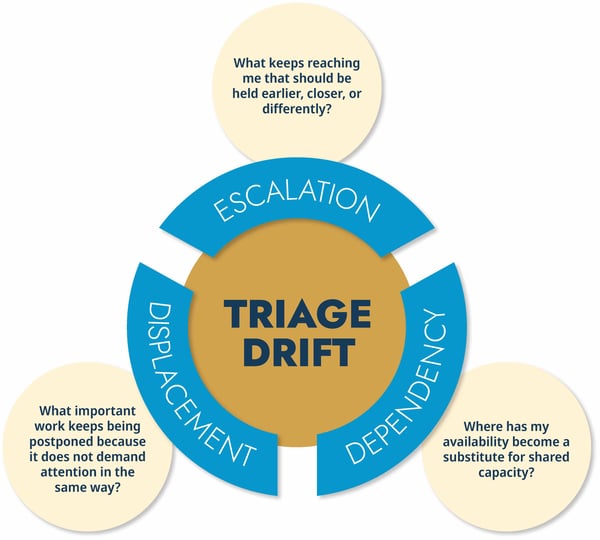
The map is designed to show where triage is no longer an event, but a pattern.
Escalation Zones are the places where issues repeatedly rise to the leader because escalation has become the path of movement. These may include recurring parent concerns, repeated behaviour escalations, staff repeatedly seeking decisions, or issues that bypass middle leadership.
The question is: What keeps reaching me that should be held earlier, closer, or differently?
Displacement Zones are the places where strategic work keeps losing its place because it does not arrive urgently. These may include instructional leadership being postponed, culture-building being delayed, feedback conversations being deferred, or strategic meetings becoming operational.
The question is: What important work keeps being postponed because it does not demand attention in the same way?
Dependency Zones are the places where the leader’s responsiveness has quietly become part of the system’s operating model. These may include the principal becoming the default resolver, middle leaders waiting for permission, teams escalating instead of deciding, or staff depending on leader intervention to move work forward.
The question is: Where has my availability become a substitute for shared capacity?
Together, these three zones reveal where triage has become more than a momentary response. They show where reactive leadership is beginning to replace strategic leadership.
Triage drift begins when response becomes the rhythm, displacement becomes normal, and dependency becomes invisible. This is leadership diagnosis.
A leader might look at one recent week and ask where most of their reactive attention went. Did it go to escalation? Did it go to urgent requests that displaced strategic commitments? Did it go to areas where the organisation has become dependent on the leader’s availability?
The answer may sit in staff dependency. It may sit in parent communication. It may sit in system reporting. It may sit in student behaviour escalation. It may sit in unclear middle leadership authority. It may sit in the leader’s own habit of being too available for every presenting issue.
The purpose is to restore intention. Diagnosis becomes easier when leaders can identify which forms of pressure are repeatedly pulling the organisation away from strategic work.
Triage asks, “What needs attention now?”
Strategy asks, “What condition would reduce the need for this to keep becoming urgent?”
That is the shift.
Triage is necessary in moments. It becomes dangerous as a model.
Prefer to listen and reflect a little more deeply?
I explore this idea more fully in this week’s podcast episode, where I unpack the research, leadership dynamics, and practical implications in greater depth.
Returning strategy to the centre
The goal is not to eliminate triage from leadership. That would be unrealistic and undesirable. Schools will always require immediate judgement, human responsiveness, and moments where leaders step directly into urgent need.
The work is to prevent triage from becoming the centre of the role. Doing that requires leadership systems that are designed deliberately rather than shaped by whatever demands attention first.
That requires leaders to notice when responsiveness is no longer protecting strategy but replacing it. It requires teams to ask where escalation has become normal. It requires systems to understand that every urgent request shapes behaviour. It requires schools to create the conditions where more work can be held strategically before it becomes reactive.
This is where leadership sustainability becomes more than wellbeing language.
A leader can be resilient, capable, disciplined, and deeply committed, and still become trapped in triage if the organisation repeatedly rewards reaction over intention. Sustaining leadership requires more than personal stamina. It requires protected judgement, strategic rhythm, and the courage to ask why certain issues keep reaching urgency in the first place.
The most important leadership work often does not arrive urgently.
Culture rarely screams. Trust rarely arrives as a deadline. Capacity-building rarely lands in the inbox with a red flag. Strategic coherence rarely interrupts the day demanding attention. Yet these are the conditions that determine whether the school becomes less dependent on triage over time.
That is why leaders must protect them deliberately. Protecting those conditions requires more than awareness; it requires shared practices that consistently turn insight into organisational behaviour.
Leadership in Triage begins to loosen when leaders ask, not only what needs response today, but what keeps becoming urgent because the deeper strategic condition has not yet been addressed.
That question does not remove pressure.
It restores leadership.
Where to go next
This article explores how constant responsiveness can quietly replace strategic leadership before leaders even recognise the shift.
-
To understand why schools increasingly operate in reaction mode, read When Everything Arrives as a Priority.
-
To examine why some leadership effort produces movement without long-term progress, read Why Leadership Efforts Grow While Traction Shrinks.
-
To diagnose where pressure is actually being generated inside leadership systems, read Leadership Pressure Triangle.
Download the full Leadership Paper
This article is part of the 12-week campaign for my Leadership Paper, The Sustainability Myth: How Great Leaders Protect What Matters When Everything Is a Priority.
If this article gave language to something you are experiencing, the full paper explores the deeper argument: educational leadership becomes unsustainable when leaders remain accountable for outcomes while becoming increasingly constrained in the professional judgement required to interpret, sequence, adapt, and decide.
